
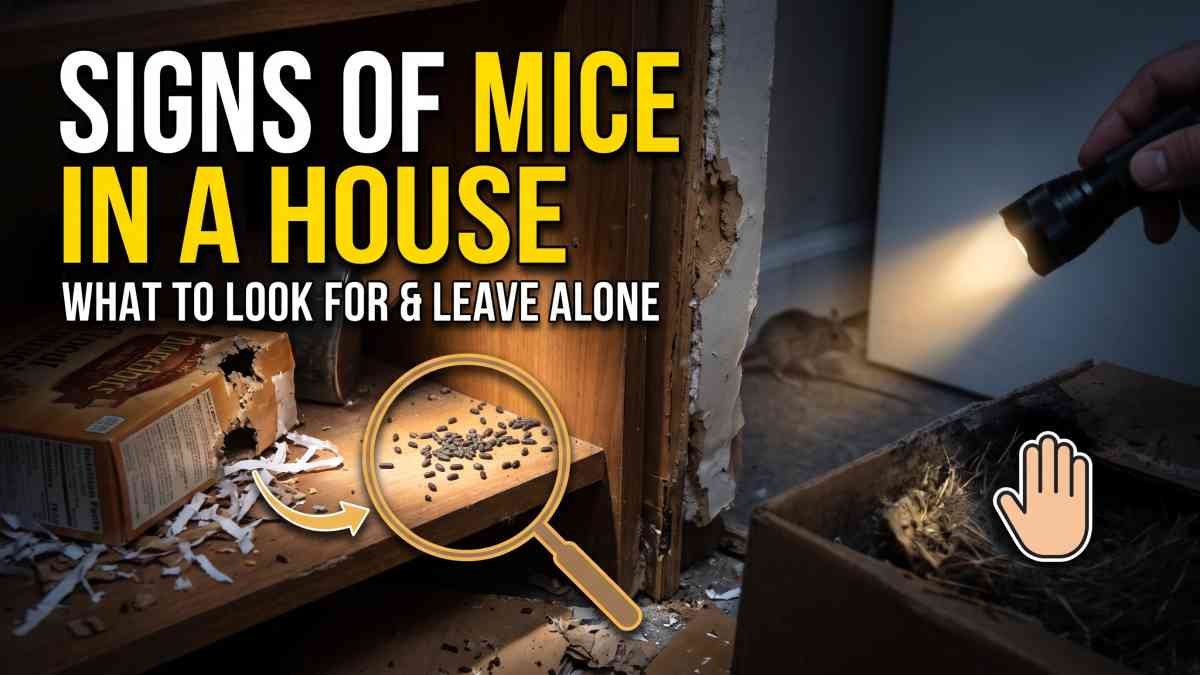
What are the signs of mice in a house? UC IPM, Cornell and the NY State Department of Health name droppings, gnaw marks, tracks, nests, a musky odor, noises after dark and pets pawing at walls. This site covers mice and rats in homes.
Look First and Touch Nothing
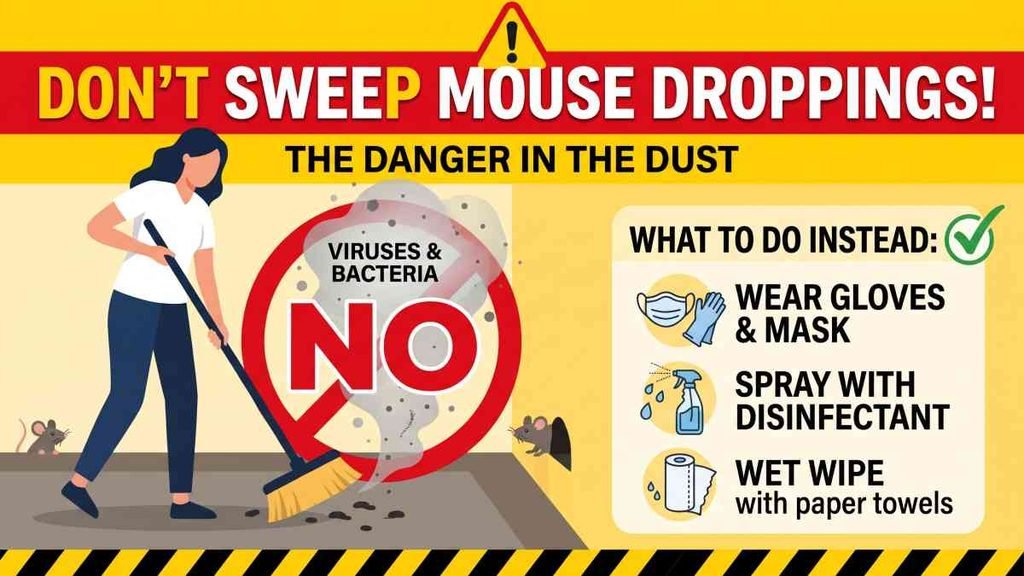
Should you touch or sweep what you find? No: the CDC says not to vacuum or sweep rodent urine, droppings or nesting materials, because that can cause tiny droplets containing viruses to get into the air. Look with a flashlight and keep children and pets away.
The CDC adds that diseases mainly reach people through contaminated air. If a recent illness may be linked to rodents, see a healthcare provider.
The Signs of Mice, With a Source for Each
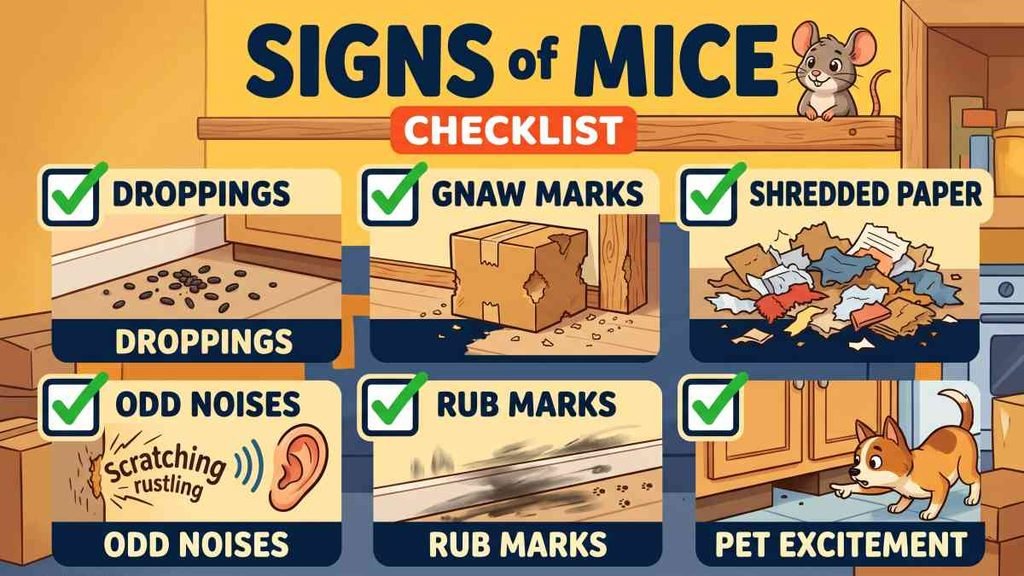
What do the sources list as signs of mice? Droppings, gnaw marks, tracks, nests, a musky odor, noises after dark, pets pawing at walls and the occasional daytime sighting. Each row in the table below names its source and the date of that source.
Swipe left or right to see the full table →
| Sign | What the source says | Source |
|---|---|---|
| Droppings | Cylindrical, typically 1/8 to 1/4 inch long | Cornell NYS IPM (no date); UC IPM (July 2025) |
| Gnaw marks | Two grooves, 1 to 2 millimeters wide | Cornell NYS IPM; UC IPM (July 2025) |
| Tracks | Footprints look like dots, 3/8 to 3/4 inch long | Cornell NYS IPM |
| Nests | Shredded paper, fibers or cloth, in sheltered spots or walls | UC IPM (July 2025); NY State Dept. of Health (July 2012) |
| Musky odor | Common in large or long-term infestations | UC IPM (July 2025) |
| Noises | You can probably hear mice after dark | NY State Dept. of Health (July 2012) |
| Pet behavior | Pets paw at walls and cabinets | NY State Dept. of Health (July 2012) |
| Daytime sightings | Mostly night activity, occasionally seen in daylight | UC IPM (July 2025) |
Note: UC IPM covers house mice in California, Cornell and NY Health are New York sources, and no source we found says how many mice a sign means.
UC IPM’s pest note on the house mouse, revised in July 2025, says droppings and gnaw marks can reveal house mouse activity, and that tracks or footprints can also indicate their presence. It adds that house mice are active mostly at night but can be seen occasionally during daylight hours.
Seeing signs of mice or rats? Call, describe what you see, and ask for a written quote before work starts.
Rodent Control Syracuse is a homeowner resource that connects you with a participating local pest control company. We don’t perform the work ourselves, and we may receive a referral fee from participating companies. Response times and prices are set by the company that takes your call.
What One Sign Does and Does Not Prove
What does one sign prove? A few droppings tell you a mouse has been there, not how many. UC IPM says a musky odor is common in large or long-term infestations, but no source we found ties any sign to a mouse count.
One dropping doesn’t prove an infestation, but droppings, gnaw marks and noises after dark in one spot point the same way.
Where to Check First and What to Leave to a Professional
Where should you check first? The NY State Department of Health says to watch for droppings and nests in storage areas such as garages and basements. Check from the floor with a flashlight, and leave a roofline, attic, crawl space or anything at height to a professional.
Cornell’s NYS Integrated Pest Management program describes mouse droppings as typically 1/8 to 1/4 inch long in its guide to mouse and rat biology and behavior. It also notes that mice can make nests inside walls, equipment and other protected places. The page shows no date.
The next question is how mice find their way in.
Syracuse Houses and Cold Months: When Signs Show Up
Reported by City-Data.com, the median Syracuse house or condo was built in 1938, and 58% of occupied housing is renter-occupied. Syracuse averages 127.8 inches of snow a year (1991 to 2020), reported by CurrentResults citing NOAA.
UC IPM, a California source, says house mice frequently enter homes in autumn when nighttime temperatures become colder. Cornell says white-footed and deer mice enter structures from fall through spring. If you rent, tell your landlord in writing; we found no source measuring signs in Syracuse homes.
If You See Signs, Describe Them to a Company
If you see droppings, gnaw marks or nests, or hear noises after dark, describe what you found, where and for how long, to a participating local pest control company so it can ask the right questions. Our guide to mouse and rat problems in Syracuse homes explains how this site works. We don’t perform the work ourselves, and the company that takes your call sets the response time, so ask it directly about any attic, crawl space or roofline you cannot reach safely.
Quick Answers About Signs of Mice
The NY State Department of Health says you can probably hear mice after dark. UC IPM says droppings and gnaw marks can reveal house mouse activity. Pets pawing at walls is another sign.
Cornell says rodent droppings are cylindrical, with pointed to rounded edges. Mouse droppings are typically 1/8 to 1/4 inch long. Do not sweep or vacuum them, per the CDC.
The NY State Department of Health says you can probably hear mice after dark, even if you don’t see them. UC IPM says they are active mostly at night. Quiet daytime hours say little.
UC IPM says house mice are active mostly at night. It adds that they can be seen occasionally during daylight hours. We found no source that ties a daytime sighting to a count.
UC IPM says house mouse nests are built in sheltered places from finely shredded paper or other fibrous material. The NY State Department of Health describes bits of cloth or shredded paper. Cornell says mice can nest inside walls.
UC IPM says house mice have a characteristic musky odor that is common in large or long-term infestations. No odor does not rule mice out. We found no source on how strong it must be.
Not the way most people try. The CDC says not to vacuum or sweep rodent urine, droppings or nesting materials, because tiny droplets containing viruses can get into the air. Heavy signs are best left to a professional.
Conclusion
Signs of mice in a house come down to droppings, gnaw marks, tracks, nests, odor and noises after dark. Look, don’t sweep, and describe what you find to a company.
Ready to talk to someone? Call, describe what you see, and ask for a written quote before work starts.
Rodent Control Syracuse is a homeowner resource that connects you with a participating local pest control company. We don’t perform the work ourselves, and we may receive a referral fee from participating companies. Response times and prices are set by the company that takes your call.
1 thought on “Signs of Mice in a House: What to Look For and Leave Alone”