
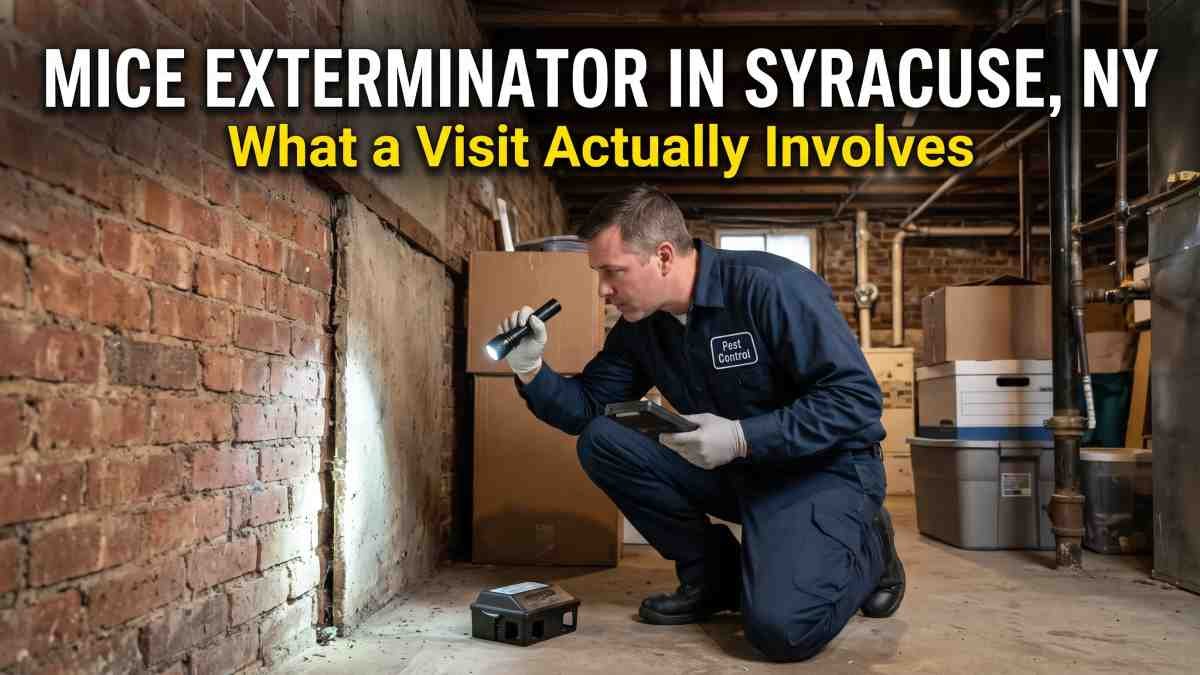
Scratching in the wall at night raises one question: what will someone actually do about it? A professional visit centers on finding where mice get in, removing the ones inside and closing the gaps. Methods vary, so know the steps before you hire a mice exterminator in Syracuse, NY.
Rodent Control Syracuse is a homeowner resource, not a pest control company. We explain mouse problems in plain language and connect you with a participating local company. This page covers mice and rats in homes, and it sits inside our wider guide to rodent control in Syracuse.
Seeing signs of mice? Call, describe what you see, and ask for a written quote before work starts.
Rodent Control Syracuse is a homeowner resource that connects you with a participating local pest control company. We don’t perform the work ourselves, and we may receive a referral fee from participating companies. Response times and prices are set by the company that takes your call.
What a Mouse Exterminator Does, Step by Step
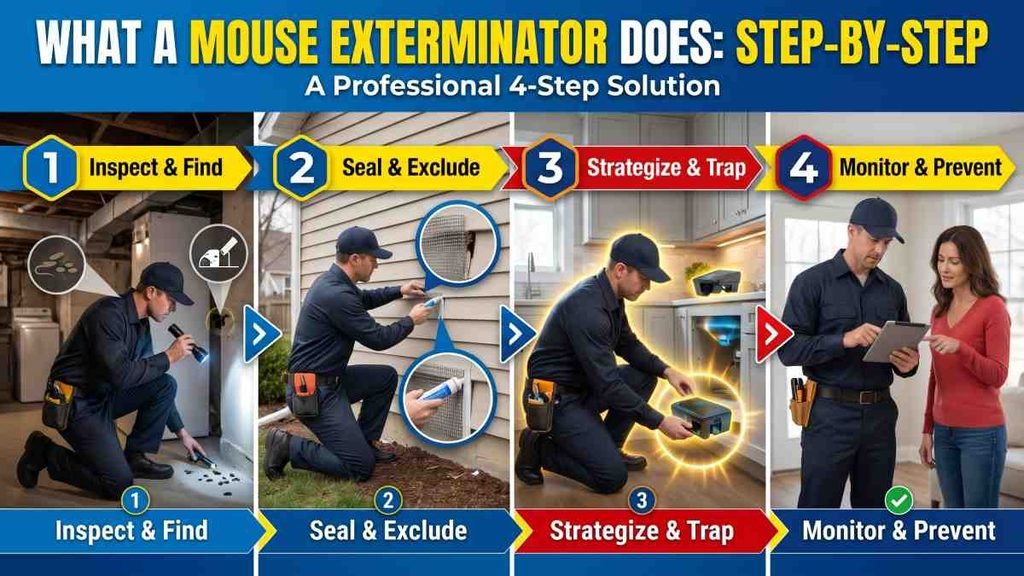
What do exterminators do for mice? The steps the sources describe are: find the entry points, remove the mice already inside, seal the gaps and check back. Exact methods vary by company, so ask which of these steps your visit includes before you agree.
That sequence is also how professional exterminators get rid of mice for good. Removing mice alone doesn’t stop new ones from coming in, and mice extermination in Syracuse that skips the sealing step treats only half the problem.
Inspection: finding where they get in
The CDC says mice can fit through a hole the width of a pencil, about 1/4 inch. That is why an inspection looks at small, easy-to-miss spots. Inside, the CDC lists the space under pipes at sinks and washing machines, behind appliances, the basement or crawl space, and the edge where the floor meets the wall. Outside, it points to rafters, eaves, soffits, vents and the gap between the foundation and the ground.
Traps and bait stations: removing the mice already inside
UC IPM, the University of California’s pest management program, calls trapping the preferred method for homes with few mice. It also notes that trapping avoids potentially hazardous rodenticides. Some companies add bait stations. Which one a company uses is its call, so ask before you agree.
Sealing the gaps: what closes a pencil-width hole
For small holes, the CDC recommends steel wool held in place with caulk or spray foam, and for larger holes hardware cloth, metal sheeting or cement. See the CDC’s guide to how to seal up your home.
Foam alone isn’t the answer. UC IPM says plastic screening, foam and other gnawable materials are ineffective on gaps larger than 1/4 inch.
The follow-up visit: checking the traps and the repairs
A follow-up visit lets the company check the traps and confirm the repairs held. Ask what that visit includes and whether it is part of the quote.
Traps, Bait Stations or Sealing: What Each One Does and Doesn’t Do
Traps remove mice that are already inside, bait stations use poison, and sealing closes the gaps mice use. Each does one job. UC IPM calls sealing the most successful and permanent form of house mouse control, and trapping the preferred method when a home has few mice.
Swipe left or right to see the full table →
| Method | What it does | What it doesn’t do | When it fits |
|---|---|---|---|
| Snap traps | Remove mice that are already inside | Don’t stop new mice from getting in | UC IPM: preferred for homes with few mice |
| Bait stations | Hold poison in a container; the EPA requires stations with consumer products | Can leave dead mice inside the structure (UC IPM); risk to pets and wildlife that eat poisoned rodents (EPA) | A method to discuss with a professional, not a default DIY choice |
| Sealing the gaps | Closes the entry points with steel wool, hardware cloth, metal or cement (CDC) | Doesn’t remove mice already inside | UC IPM: the most successful and permanent form of control |
Note: This table summarizes UC IPM, EPA and CDC guidance. We don’t publish success rates, and which method fits depends on your home. Ask the company which of these it will combine for mice control in Syracuse, NY.
Is It Mice? Three Quick Checks Before You Call
Droppings, noises and gnaw marks are the three fastest checks. Look for droppings along walls and in cabinets. Listen for scratching in the walls, especially at night. Check wires, boxes and food packaging for gnaw marks.
If you find droppings, don’t sweep or vacuum them. The CDC says that can put tiny droplets carrying viruses into the air. Try not to panic: finding signs just means it’s time to ask someone to look.
Mouse Poison Around Children and Pets: What the EPA Requires
Poison needs the most care around children and pets. The EPA requires consumer mouse and rat poisons to come with bait stations and bans loose bait. It warns that pets and wildlife can also be poisoned if they eat rodents that consumed certain poisons.
The EPA also requires tamper-resistant stations for uses around children, pets or outdoors. It has barred consumer sales of four second-generation anticoagulant ingredients, and it says baits containing them may still be used in homes by pest control professionals. That is a good reason to ask any company what it will put in your home, and where.
Heard it again tonight? Call, describe what you see, and ask for a written quote before work starts.
Rodent Control Syracuse is a homeowner resource that connects you with a participating local pest control company. We don’t perform the work ourselves, and we may receive a referral fee from participating companies. Response times and prices are set by the company that takes your call.
Why Syracuse Winters Push Mice Indoors
Cold weather sends mice looking for shelter. Cornell IPM notes that deer mice move indoors in autumn as temperatures drop, and Syracuse averages 127.8 inches of snow a year, as reported by CurrentResults citing NOAA’s 1991-2020 normals for Syracuse Hancock International Airport.
Cornell’s note is about deer mice, and the snowfall figure is a regional average. Treat both as a seasonal pattern worth knowing about, not a prediction for your house.
How Long It Takes and How Many Visits to Expect
Nobody can honestly promise an exact number of days or visits before inspecting your home. How fast the problem grows and how many gaps there are both matter. Ask the company how many visits its plan includes and what each one covers.
Mice breed fast, which is why a mouse follow-up visit matters. According to UC IPM, a female can have roughly 5 to 10 litters a year with about 5 or 6 pups each. Young are born 18 to 21 days after conception and mature at 5 to 6 weeks. So how long does mouse extermination take? It depends on how many mice there are and how well the gaps get closed. We can’t give a verified standard for how many visits to get rid of mice, so ask for the company’s own terms.
Are Mice Exterminators Worth It, or Can You Handle Mice Yourself?
A professional makes sense when mice are in your walls, you can’t find the entry points, or poison would be involved around children and pets. A single mouse and one obvious gap is a job you can start yourself, within the limits described below.
Here is where the line sits for DIY vs professional mouse control. Safe to do yourself: store food in sealed containers, wet-clean droppings the way the CDC describes (soak them with bleach solution or an EPA-registered disinfectant, then wipe up, never sweep or vacuum) and plug a very small gap with steel wool. Better left to a professional: poison, a large problem and any work at height or in a crawl space.
When you call a mouse exterminator in Syracuse, NY, the price depends on the home, the number of entry points and the visits involved, so we don’t print figures here. To see what drives a quote, read what rodent exclusion costs in Syracuse.
Before You Say Yes: Seven Questions to Ask the Company
Before you hire a mice exterminator in Syracuse, NY, seven questions cover most of what to ask a pest control company. Each one comes with the reason it matters.
1. May I see your pesticide license? Why it matters: The EPA tells homeowners to ask to see the company’s license, and to call the state pesticide regulatory agency if they have concerns.
2. Is the work insured? Why it matters: The EPA’s hiring page points to checking insurance, so you know who pays if something is damaged.
3. Which methods and products will go into my home? Why it matters: The EPA says professionals may still use certain baits in homes, so you should know what is being used.
4. Are children or pets at risk, and how will that be handled? Why it matters: The EPA warns that pets and wildlife can be poisoned by eating poisoned rodents.
5. Will the quote be in writing and list the work and the total? Why it matters: A written quote for mouse control lists the work, the methods, the materials and the total, so nothing changes after you agree.
6. Which entry points will you seal, and with what? Why it matters: UC IPM says gnawable materials don’t hold up on gaps larger than 1/4 inch, so the material matters.
7. What does the follow-up include? Why it matters: Mice breed quickly, and a follow-up is how you find out whether the work held.
The US EPA tells homeowners to ask to see a pest control company’s license before work begins, and to call the state pesticide regulatory agency if they have concerns. Its page on tips for hiring a rodent control professional also points to checking insurance.
Older Homes and Rentals in Syracuse: What Changes
Reported figures point to older housing and many renters in Syracuse. City-Data reports a median build year of 1938 for houses and condos, and says 58% of occupied housing is renter-occupied (35,971 of 61,878 units), based on 2000-2023 data. Those are third-party figures, not official ones.
We can’t say how many Syracuse homes have gaps, but any older house is worth checking at the spots the CDC names: under pipes, around the foundation and near vents. If you rent, check your lease and talk to your landlord. For anything about rules in your building, check with your landlord, the City of Syracuse or the Onondaga County Health Department.
Straight Answers on Mouse Control in Syracuse
A professional can remove the mice inside and close the gaps, and UC IPM calls sealing the most successful and permanent form of house mouse control. Results depend on your home and how well the gaps are closed, so be cautious of anyone who promises one before inspecting.
The mouse-control methods UC IPM names are exclusion, trapping and rodenticide bait. We couldn’t find a source that says whether companies use sprays for mice, so we won’t claim either way. Ask the company which method and which product it will use in your home.
Not automatically. The EPA requires bait stations with consumer poisons and tamper-resistant stations around children and pets, and warns that pets and wildlife can be poisoned by eating poisoned rodents. Ask any company what it will use and where it will go.
Sealing is the step UC IPM calls the most successful and permanent. It also says plastic screening, foam and other gnawable materials are ineffective on gaps larger than 1/4 inch. The CDC pairs steel wool with caulk or foam for small holes and uses metal, hardware cloth or cement for larger ones.
UC IPM says trapping is the preferred method for homes with few mice. It doesn’t rely on potentially hazardous rodenticides, and you can see the results. You still need to find how they got in.
Yes. The EPA says to ask to see the company’s license. If you have concerns, call your state pesticide regulatory agency.
UC IPM says poison often results in mice dying inside the structure. That can cause odor problems, which trapping avoids. If smell is a concern, tell the company before work starts.
Rodents can carry diseases, and the CDC lists hantavirus among them. The CDC says rodent-borne diseases mainly spread when people breathe contaminated air, which is why it says not to sweep or vacuum droppings. Talk to a healthcare provider if you think an illness may be linked.
Check your lease and tell your landlord about the problem. We don’t know the rules that apply to your building, so we won’t guess. The City of Syracuse or the Onondaga County Health Department can tell you.
Yes, and you should. A written quote should list the work, the methods, the materials and the total. If a company won’t put it in writing, that is a reason to keep looking.
Describe What You’re Hearing, Then Ask for a Written Quote
Tell the company what you see and hear, then ask for a written quote before you agree to anything. If you have a question about this page, send us a message (https://rodentcontrolsyracuse.com/contact/). Whichever mice exterminator in Syracuse, NY you choose, the steps above are what to expect and what to ask.
Ready to talk to someone? Call, describe what you see, and ask for a written quote before work starts.
Rodent Control Syracuse is a homeowner resource that connects you with a participating local pest control company. We don’t perform the work ourselves, and we may receive a referral fee from participating companies. Response times and prices are set by the company that takes your call.