
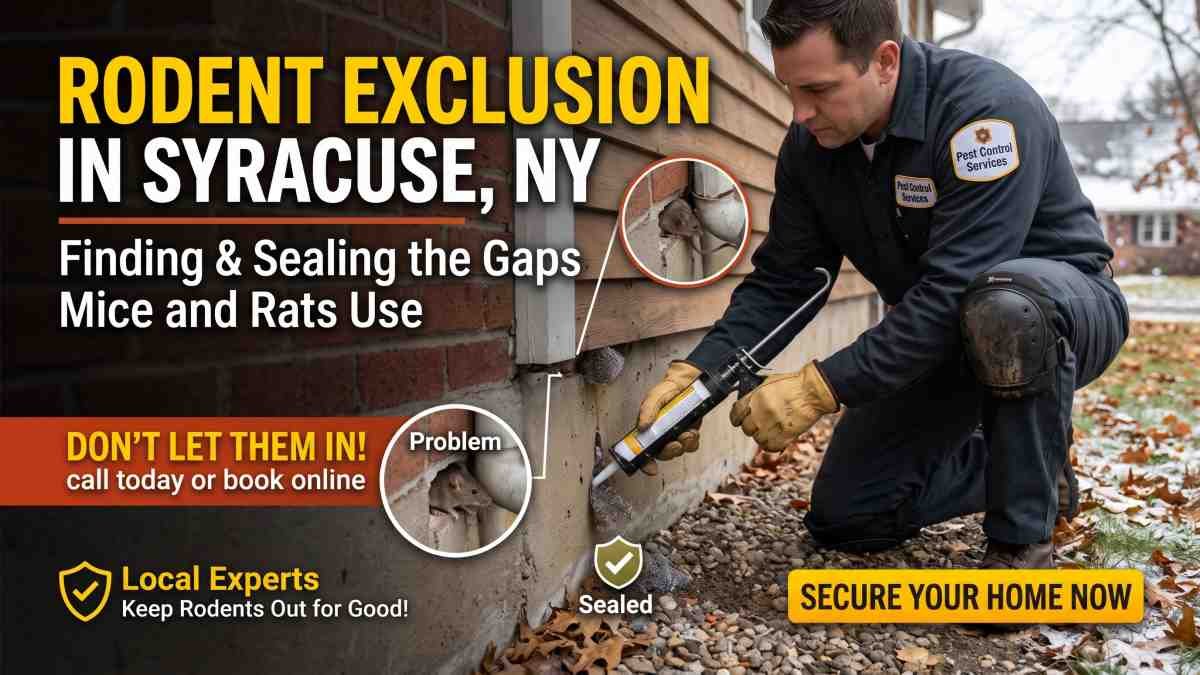
Rodent exclusion means finding every gap mice and rats use to get in, dealing with any rodents already inside, and sealing the openings with materials they can’t chew through. Cold weather sends rodents looking for shelter, and a proper rodent exclusion Syracuse job also checks back afterward to confirm nothing new has opened.
If you searched for rodent exclusion Syracuse NY homeowners rely on, this guide covers where gaps show up, which materials hold, what is safe to do yourself, and what to ask a company first. For the wider picture, see the Syracuse overview on our homepage. This site covers mice and rats in homes, not other wildlife or commercial buildings.
What exclusion is, and why the order of work decides whether it holds
Exclusion is a sequence, not a single repair: inspect inside and out, remove rodents already in the house, seal each opening with a material they can’t gnaw through, then monitor. Skipping the second step leaves rodents shut inside your walls.
Cornell Integrated Pest Management says trapping and baiting bring numbers down quickly, while long-term prevention comes from sanitation plus sealing. That is the logic behind rodent proofing Syracuse houses need before winter. A wildlife-damage extension guide warns that closing walls on live rodents brings odors, stains and insects feeding on carcasses. EPA adds that live-trapped rodents released outdoors may return unless entry points are sealed. So the order matters as much as the materials, and any rodent exclusion Syracuse homeowners can judge fairly starts with one question: what happens to the rodents already inside?
Signs that gaps are already in use
Droppings, gnaw marks, oily rub marks, night scratching and nesting material all suggest rodents are using a way in. Cornell says an inspection looks for droppings, gnaw marks, footprints and oily brown sebum trails.
Swipe left or right to see the full table →
| What you see | What it suggests | What to do next |
|---|---|---|
| Droppings along walls or in cabinets | Rodents are active nearby, though a pile alone doesn’t prove a large population (Cornell) | Note where; clean safely (see the safety section) |
| Gnaw marks on packaging, wood or an opening’s edge | Chewing toward food or at a way in | Photograph it; look for a gap close by |
| Oily brown rub marks on walls or pipes | A regular travel route (Cornell lists sebum trails as a clue) | Follow the trail to where it starts |
| Scratching at night | Movement in walls or ceilings; the noise doesn’t tell mouse from rat | Write down where and when |
| Shredded paper, fabric or insulation | Rodents may be sheltering there | Don’t handle it bare-handed; see the CDC steps below |
Note: Cornell cautions that dropping counts alone don’t prove a full infestation, so treat this table as a prompt to look closer, not a diagnosis.
Seeing signs of mice? Call, describe what you see, and ask for a written quote before work starts.
Rodent Control Syracuse is a homeowner resource that connects you with a participating local pest control company. We don’t perform the work ourselves, and we may receive a referral fee from participating companies. Response times and prices are set by the company that takes your call.
Where mice and rats get into Syracuse houses
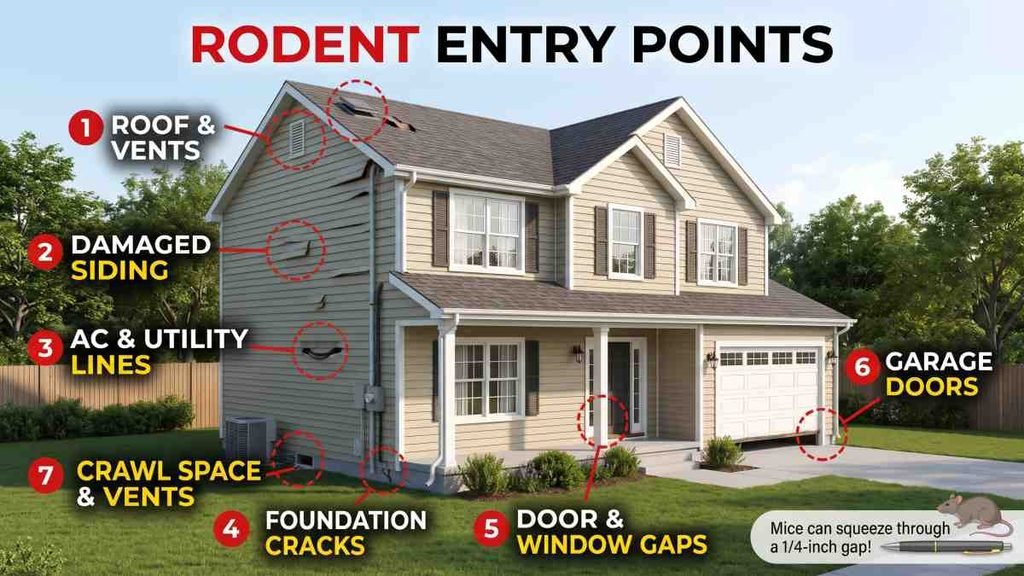
According to the CDC, mice can fit through a hole about as wide as a pencil, roughly 1/4 inch. They look for gaps around pipes, dryer and floor vents, utility lines, the foundation, doors, soffits and rooflines. Sealing those entry points is what keeps rodents out once the ones inside are gone.
To seal rodent entry points in Syracuse houses, work from the CDC’s checklist: cabinets, behind appliances, pipes under sinks, dryer and floor vents, utility lines, the basement or crawl space, and floor drains.
Around pipes, dryer vents and utility lines
Any space left around a pipe, cable or vent where it passes through a wall is a possible way in.
Foundation, sill and siding joints
The extension guide names the gaps where siding or framing meets the foundation. The CDC also lists the gap between the foundation and the ground.
Door bottoms and garage doors
The extension guide says an exterior door should leave no more than 1/4 inch at the bottom, and that rubber and vinyl weather stops get gnawed through. In an attached garage, check the bottom seal for a visible gap or chewed edge first.
Rooflines, soffits and vents
The CDC’s outside list includes rafters, gables, eaves, soffits, and attic and crawl-space vents. Cornell adds that white-footed and deer mice often enter where wires meet a building or where tree branches bridge to the roof.
In a duplex or apartment, pipes and floor drains may connect to neighboring units, so tell the property owner instead of sealing alone. For who handles it, check with your landlord, the City or the Onondaga County Health Department.
A gap-size guide: what stops a mouse and what stops a rat
The extension guide says mice can gnaw through openings over 1/4 inch and rats through openings over 1/2 inch. Sealing gaps and cracks starts with sizing them, because the right material depends on the opening.
Mouse-sized gaps: pencil-width and smaller
For mouse proofing Syracuse NY homes, the benchmark is a pencil. The CDC suggests steel wool with caulk or spray foam for small holes. The extension guide calls steel wool or copper gauze a temporary plug and says patching compound over it lasts longer. Steel wool can rust and stain.
Larger openings and vents
For larger openings the CDC names lath screen or metal, cement, hardware cloth and sheet metal. The extension guide specifies woven hardware cloth: 24-gauge with 1/4 inch openings for mice, 19-gauge with 1/2 inch openings for rats. Mesh smaller than 1/2 inch noticeably reduces airflow, so 1/2 inch is the compromise on vents.
What rodents chew through
Rubber and vinyl weather stops get gnawed through, and steel wool alone is temporary. That is why a written scope should name the material at each opening.
Swipe left or right to see the full table →
| Opening | Material named | Source |
|---|---|---|
| Small holes | Steel wool with caulk or foam; copper gauze with patching compound | CDC; extension guide |
| Larger holes | Hardware cloth, lath, sheet metal, cement | CDC; extension guide |
| Vents | Screening; mesh under 1/2 inch cuts airflow | Extension guide |
| Pipe and cable entries | Mortar or concrete patch, metal collars | Extension guide |
| Door bottoms | Metal flashing; gap no more than 1/4 inch | Extension guide |
Note: These are the materials the sources name, not a repair plan. Gap size, location and building type change what a company would use.
The CDC says mice can fit through a hole about as wide as a pencil, roughly 1/4 inch, so a gap that looks too small to matter can still be a way in. Its guidance for small holes is steel wool with caulk or spray foam around it, and for larger openings lath screen or metal, cement, hardware cloth or sheet metal cut to fit around pipes (CDC: How to Seal Up to Prevent Rodents). That is why a written scope should name the material used at each opening, not just say “sealed.”
What is safe to do yourself and what to leave to a professional
Safe to do yourself
Store food in sealed containers, wipe up spills, and keep pet food and trash from sitting out. The CDC also says very small gaps can be plugged with steel wool and caulk.
Leave to a professional
Poison baits are not a DIY job. EPA says baits must go in tamper-resistant bait stations, out of reach of children and pets, and Cornell notes baits are pesticides with risks to non-target animals. A heavy infestation, work in a crawl space or at height, and areas you can’t reach safely also belong to a professional. So do rodents in heating and cooling ducts, per the CDC.
Handling droppings and nests safely
The CDC says diseases spread mainly by breathing contaminated air, so don’t sweep or vacuum droppings, nests or urine. Air the space out for 30 minutes first. Wear rubber or plastic gloves, wet the droppings with a bleach solution or an EPA-registered disinfectant and let it soak, then double-bag them with any dead rodents or nests. Heavy infestations need extra precautions.
How a professional exclusion job runs, step by step
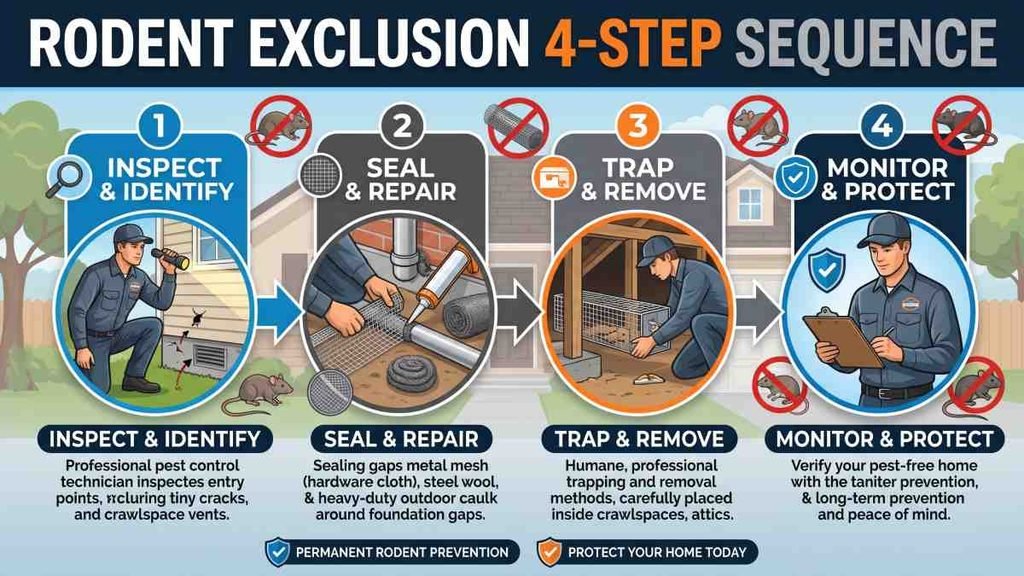
A typical rodent exclusion job has four stages: inspect the house inside and out, deal with rodents already inside, seal every opening found with a suitable material, then follow up and monitor. The company that takes your call sets the real scope and order.
Rodent Control Syracuse doesn’t perform this work. The steps below describe general practice from Cornell, CDC and extension sources. What rodent exclusion services Syracuse companies offer will differ, so use them as a yardstick, not a promise.
Rodent entry point inspection, inside and out
Cornell describes a good inspection as working low to high, looking for droppings, gnaw marks, footprints and sebum trails. Species matters: house mice mostly live indoors, while white-footed and deer mice often come in from exterior points.
Dealing with rodents already inside before the walls are closed
The rule is to remove rodents before sealing. The extension guide recommends trapping before sealing interior walls, and Cornell says a poisoned rodent can die in a wall void, with odor lasting days for mice and weeks for rats. For mice specifically, our page on how mouse problems are treated explains what that visit involves.
Sealing and finishing
Each opening gets a material matched to its size and location, as in the table above: patching compound over steel wool, metal around pipes, flashing at a door base.
Follow-up inspection and keeping rodents out long term
A follow-up inspection shows whether the work held. Cornell says new droppings after cleaning mean the plan isn’t working yet, and it advises keeping monitoring records. Long-term rodent prevention means checking old repairs and looking for new openings.
Heard it again tonight? Call, describe what you see, and ask for a written quote before work starts.
Rodent Control Syracuse is a homeowner resource that connects you with a participating local pest control company. We don’t perform the work ourselves, and we may receive a referral fee from participating companies. Response times and prices are set by the company that takes your call.
Trapping, baiting and sealing compared
Trapping vs baiting vs exclusion is not a contest. Each does one job.
Swipe left or right to see the full table →
| Method | What it does | What it does not do | Main risk or limit |
|---|---|---|---|
| Snap traps | Reduces numbers quickly (Cornell) | Doesn’t close the way in | Keep out of reach of children and pets (EPA) |
| Glue boards | Catches some rodents | Cornell: poorly suited; mostly juveniles, some escape | Humaneness concern (Cornell) |
| Bait in tamper-resistant stations | Reduces numbers | Doesn’t close the way in | Non-target risks; poisoned rodents can die in walls |
| Sealing | Closes entry points | Doesn’t remove rodents inside | Needs the right material at each gap |
Note: This table uses only what Cornell and EPA state. No success rates are given because none could be verified.
Cornell Integrated Pest Management describes trapping and baiting as ways to bring numbers down quickly, with long-term prevention coming from sanitation and sealing. It also cautions that glue traps are a poor fit for rodents, and that baits are pesticides that belong in tamper-resistant stations away from children and pets (Cornell IPM: Managing Mice and Rats). Sealing on its own does not remove rodents already inside, and trapping on its own does not close the way in, which is why the two go together.
What affects how long the job takes and how many visits
How long a rodent exclusion job takes depends on the number and location of entry points, building size and foundation type, whether rodents are still inside, how much food and shelter is available, and how long the problem has existed. Any firm timeline only makes sense after someone has inspected the house.
What the work costs depends on those same factors, and this page doesn’t quote figures. For a breakdown of what affects the final bill, see our guide. With any company, ask for a written quote listing the work, the methods, the materials and the total before work starts.
Syracuse specifics: autumn move-ins, snow cover and older foundations
Autumn and early winter
Cornell says white-footed and deer mice move indoors in autumn, and SUNY ESF notes Syracuse snow squalls can start as early as mid-November. Check the outside before snow hides the lower walls.
Snow, ice and access
SUNY ESF reports that Syracuse sits about 40 miles south of Lake Ontario, gets lake-effect snow and averages just over 100 inches a year. Deep snow hides the foundation line.
Older homes, basements and garages
Reported by the American Community Survey as republished by Point2Homes and NeighborhoodScout, roughly four in ten Syracuse homes were built in 1939 or earlier. In a house with older stone or brick foundations, check what the CDC and extension guide name: where siding or framing meets the foundation, and where pipes and utility lines enter the basement or crawl space.
How to choose a rodent exclusion company in Syracuse
Cornell advises asking about an integrated pest management approach: sanitation, sealing and monitoring alongside any trapping. Use these six questions.
- Ask to see the company’s license. If in doubt, contact the state pesticide regulatory agency, as EPA advises. Why: it is the first check EPA’s hiring guidance names.
- Ask for a written scope listing each opening and the material used. Why: “sealed” tells you nothing, and the right material changes with the gap.
- Ask how rodents already inside are handled before sealing. Why: closing walls on live rodents causes odors and insect problems.
- Ask where any baits go. Confirm tamper-resistant stations away from children and pets. Why: that is EPA’s standard.
- Ask what the follow-up includes and what any guarantee covers, in writing. Why: a guarantee only helps if you know its terms.
- Ask what you need to do first. Why: blocked access slows the job.
Questions Syracuse homeowners ask
It is the work of keeping mice and rats out by closing the ways they get in. A proper job inspects, deals with rodents already inside, seals each opening with a suitable material, and checks back. Cornell says long-term prevention comes from sanitation plus exclusion.
About the width of a pencil, roughly 1/4 inch, according to the CDC. Rats need more room, since the extension guide says they can gnaw through openings over 1/2 inch.
The CDC says small holes can be plugged with steel wool plus caulk or foam, which most homeowners can do. Larger openings and anything at height or in a crawl space are harder to do safely. If you can’t reach an area, the CDC advises contacting a pest control specialist.
Yes. Closing walls on live rodents can lead to odors, stains and insects feeding on carcasses, the extension guide warns. Trapping first, then sealing, avoids that.
On its own it is a temporary plug, per the extension guide. Patching compound over it lasts longer, and the CDC pairs it with caulk or foam. Steel wool can also rust and leave stains.
Cornell says new droppings after cleaning mean control isn’t working yet. Rodents may still be inside, or an opening may have been missed.
Cornell says glue traps are poorly suited to rodents: they mostly catch juveniles, some animals escape, and humaneness is a concern. If you use any trap, EPA says to keep it where children and pets can’t reach.
Autumn is sensible, since Cornell says white-footed and deer mice move indoors then and SUNY ESF notes snow squalls can start as early as mid-November. Check the outside before snow covers the foundation line.
Each opening found, the material used at each, how rodents already inside will be handled, where any baits go, and what the follow-up covers. Get the total in writing before work starts.
EPA says baits must go in tamper-resistant bait stations, and baits and traps must be out of reach of children and pets. Cornell adds that baits are pesticides with risks to non-target animals. For those reasons, poison is a job for a professional.
Ready to talk to a participating company?
To get a clear picture of the rodent exclusion Syracuse homes need, scoped for your own house, call and describe what you’ve found. Ask for a written scope and quote before any work begins.
Ready to talk to someone? Call, describe what you see, and ask for a written quote before work starts.
Rodent Control Syracuse is a homeowner resource that connects you with a participating local pest control company. We don’t perform the work ourselves, and we may receive a referral fee from participating companies. Response times and prices are set by the company that takes your call.