
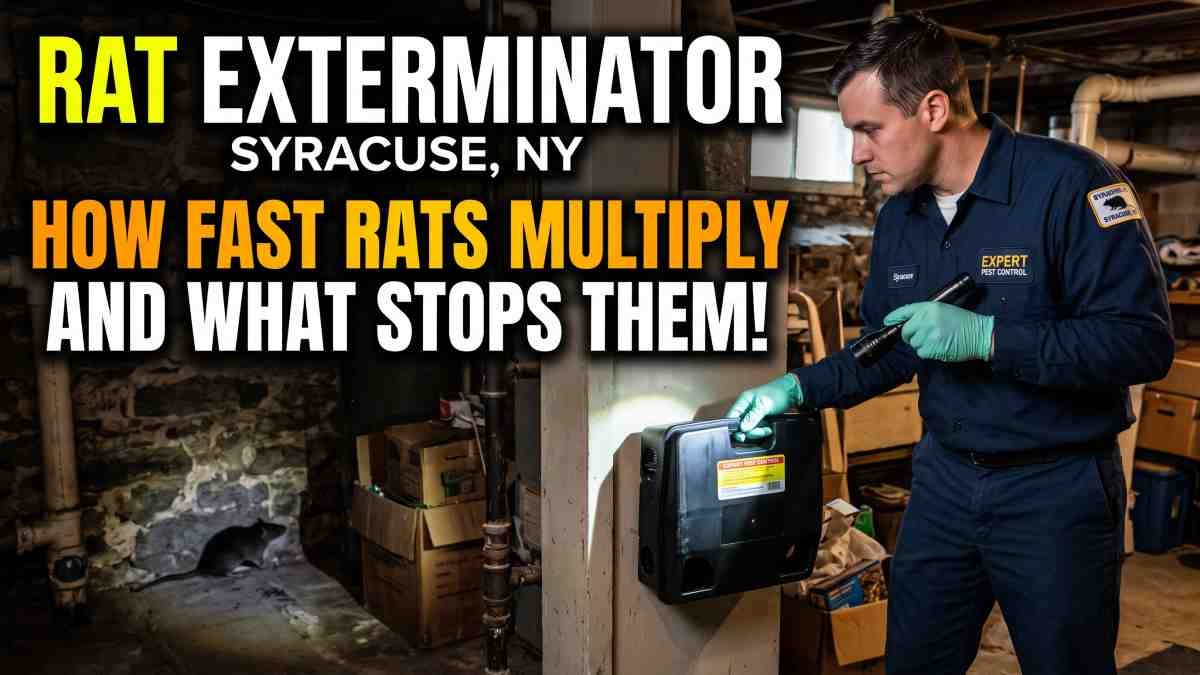
Rats multiply fast, and that shapes how they’re dealt with. The University of California’s pest management program (UC IPM) says an average female Norway rat has 4 to 6 litters a year and can wean 20 or more young annually. So a good rat exterminator in Syracuse removes the rats, seals what they used and plans a follow-up.
Rodent Control Syracuse is a homeowner resource, not a pest control company. We cover mice and rats in homes, and our guide to rodent control in Syracuse explains the wider picture. This page is about rats.
Seeing signs of rats? Call, describe what you see, and ask for a written quote before work starts.
Rodent Control Syracuse is a homeowner resource that connects you with a participating local pest control company. We don’t perform the work ourselves, and we may receive a referral fee from participating companies. Response times and prices are set by the company that takes your call.
A Rat Problem Grows Faster Than Most People Expect
How fast do rats multiply? UC IPM says the average female Norway rat has 4 to 6 litters per year and can successfully wean 20 or more offspring annually. Young rats can also squeeze beneath a door with only a 1/2-inch gap, and their burrows are often found along building foundations.
That isn’t a reason to panic. It’s a reason to act early, because the longer a problem runs, the more rats there can be.
Picture an older Syracuse house with a crack where the foundation meets the soil and a garbage can nearby. UC IPM says Norway rat burrows may be found along building foundations, beneath rubbish or woodpiles, and around gardens.
Rats or Mice? Four Signs That Point to Rats
How can you tell if you have rats or mice? UC IPM lists four signs that point to rats: gnaw marks about 1/6 inch wide, smudge marks where fur rubs along beams and pipes, burrows along foundations, and droppings near pet food.
Swipe left or right to see the full table →
| Sign | What points to rats | Source |
|---|---|---|
| Gnaw marks | Tooth marks about 1/6 inch (4 mm) wide. Mice leave smaller marks | UC IPM |
| Rub marks | Smudge marks where fur rubs against beams, rafters, pipes and walls | UC IPM |
| Burrows | Holes along foundations, or beneath debris, compost piles and garbage cans | UC IPM |
| Droppings | Found near pet food | UC IPM |
Note: This table lists signs, not proof. We can’t see your house, and UC IPM gives no droppings size, so we don’t either.
Telling them apart matters because the visit is planned around the animal. If your signs lean toward mice, our guide to what a mouse control visit involves in Syracuse covers that visit instead. When you call, describe exactly what you saw and where.
How Rats Get In: Door Edges, Vents and Foundation Gaps

How do rats get into a house? UC IPM says young rats can squeeze beneath a door with a 1/2-inch gap, and that every hole larger than 1/4 inch should be sealed. The CDC adds vents, windows, utility lines and the gap between the foundation and the ground to the list.
Why are rats entering my house? Usually a gap plus a reason. UC IPM links rats to burrows beneath garbage cans and droppings near pet food, so food within reach is part of the story.
Materials matter. UC IPM says vent covers should be 18-gauge, 1/2-inch galvanized expanded metal or heavier, and never lightweight chicken wire, since rats can pass through the openings.
For rat entry point sealing, the CDC’s list runs from the roof area (rafters, gables, eaves and soffits) down to holes around electrical, plumbing, cable and gas lines. In an older Syracuse house, that means walking the basement, crawl space and roofline.
What a Rat Exterminator Does, Step by Step
What do rat exterminators do? Following UC IPM and CDC guidance, the work has four parts: inspecting for burrows and travel routes, removing rats with traps or bait stations, sealing the gaps they used, and cleaning up with a follow-up. Companies differ, so ask which parts your quote includes.
How do exterminators get rid of rats? Not with one tool. The CDC’s approach has three steps, seal up, trap up and clean up, and a rat exterminator in Syracuse should say where each one fits.
Inspection: Finding Burrows and Travel Routes
A rat inspection in Syracuse, NY starts with the places UC IPM names: foundations, spots beneath rubbish or woodpiles, gardens, and rub marks along beams, pipes and walls. The goal is to learn where the rats travel and where they got in. Ask what the company’s inspection covers.
Trapping and Bait Stations: Removing the Rats Inside
UC IPM says to use as many traps as practical so the trapping time stays short, and that bait stations belong in rat travel ways or near burrows. This is the company’s job, not a weekend project.
Sealing What They Used
The CDC recommends steel wool with caulk or spray foam for small holes, and lath screen, metal, cement, hardware cloth or metal sheeting for larger ones. Metal mesh, never chicken wire, is the rule for vents.
Cleanup and the Follow-Up Visit
Cleaning up is the CDC’s third step. Ask whether the cleanup is part of the visit or priced separately, and whether a follow-up visit is included. UC IPM’s breeding numbers are the reason to want that follow-up in writing.
Traps, Bait Stations or Sealing: What Each One Does for Rats
Traps remove rats already inside, bait stations hold rodenticide in a container, and sealing closes the gaps rats used. UC IPM describes all three, and the CDC pairs sealing with trapping. Ask which methods will go into your home before you agree to the work.
Rat trapping vs rat baiting is the question under most calls. The table shows how the options differ.
Swipe left or right to see the full table →
| Method | What it does | What it doesn’t do | Risk |
|---|---|---|---|
| Traps | Remove rats already inside. UC IPM says use as many as practical so trapping time stays short | Don’t close the entry points | Ask who places and checks them |
| Bait stations | Hold rodenticide in a container placed in rat travel ways or near burrows (UC IPM) | Don’t close the entry points | Nontarget poisoning of pets and wildlife can occur (UC IPM) |
| Sealing | Closes gaps larger than 1/4 inch with metal mesh, steel wool or hardware cloth (UC IPM, CDC) | Doesn’t remove rats already inside | Chicken wire and lightweight materials fail (UC IPM) |
Note: This table summarizes UC IPM and CDC guidance. We show no success rates, because we can’t verify any.
Rat Poison Around Children and Pets: What UC IPM and the EPA Say
Is rat baiting safe around children and pets? It can harm them: UC IPM says nontarget poisoning of pets and wildlife can occur, and even a single dead rodent might be enough to poison a pet. The EPA requires consumer rat poisons to come with bait stations.
The EPA also bans loose bait and bars the sale of four second-generation anticoagulants to consumers, though professionals may still use those baits in homes. Pets and wildlife can be poisoned if they eat rodents that consumed them.
Is professional rat extermination safe for pets? We can’t promise that for any company, so ask which product will be used, where it will go and how it stays away from children and pets.
Heard it again tonight? Call, describe what you see, and ask for a written quote before work starts.
Rodent Control Syracuse is a homeowner resource that connects you with a participating local pest control company. We don’t perform the work ourselves, and we may receive a referral fee from participating companies. Response times and prices are set by the company that takes your call.
What Rats Can Spread, and Why Droppings Are Not a Sweep-Up Job
Can rats spread diseases to humans? The CDC says yes: rodents spread disease through droppings, urine, saliva and bites, and when people breathe in or eat contaminated material. It names leptospirosis, rat-bite fever, salmonellosis and hantavirus, so treat droppings with care.
The CDC’s guide to controlling wild rodent infestations is built around three steps: seal up, trap up and clean up. Cleaning up droppings is a job with its own safety steps, so leave heavy cleanup to a professional.
Older Syracuse Houses, Foundations and Rentals
City-Data reports a median build year of 1938 for Syracuse houses and condos, and says 58% of occupied housing is renter-occupied (35,971 of 61,878 units), based on 2000-2023 data. These are third-party figures.
UC IPM says Norway rat burrows may sit along building foundations, so the ground line of an older house deserves a look. We found no source that says older Syracuse homes have more rats, so we don’t claim it.
Syracuse averages 127.8 inches of snow a year, reported by CurrentResults citing NOAA’s 1991-2020 normals. We found no source on when rats move indoors in Central New York, so we make no seasonal claim.
Swipe left or right to see the full table →
| Home type | Where a company may look | Basis |
|---|---|---|
| Older house with a stone or brick foundation | The line where the foundation meets the ground, and holes around utility lines | UC IPM and CDC |
| Basement | Pipe and utility openings, and vents | CDC list of places to check |
| Rental unit | Which gaps are yours to report and which belong to the building | Ask your landlord |
Note: This table is context, not a finding. We can’t see your house, so it shows where a company may look, not what it will find.
If you rent, check your lease and tell your landlord before you pay for anything. For building rules, ask the City of Syracuse or the Onondaga County Health Department.
Before You Say Yes: Seven Questions for a Rat Control Company
What should you ask a rat control company before work starts? Start with its New York registration and the technician’s certification, then ask about methods, pet safety, entry points, the written quote and the follow-up. Each question below comes with its reason.
1. Is the business registered with the NYS DEC, and is the technician certified? Why it matters: Under rodent control regulations in New York State, certification is required to apply any pesticide commercially, and you can look both up in the state’s database.
2. Is the work insured? Why it matters: The EPA tells homeowners to check for appropriate insurance.
3. Which methods and products will go into my home? Why it matters: Traps, bait stations and sealing carry different risks, as the table above shows.
4. Are children or pets at risk, and how is that handled? Why it matters: UC IPM says even a single dead rodent might be enough to poison a pet.
5. Will the quote be in writing and list the work and the total? Why it matters: A written total lets you compare companies.
6. Which entry points will be sealed, and with what? Why it matters: UC IPM says 1/2-inch galvanized mesh works and chicken wire does not.
7. What does the follow-up include, and is it in writing? Why it matters: Rats breed quickly, so a follow-up is how you find out whether the first visit worked.
In New York, certification is required to apply any pesticide commercially, and a business that offers pesticide services for hire must be registered with the state’s Department of Environmental Conservation. The DEC’s page on pesticide applicator and technician certification points homeowners to its pesticide administration database, where you can look up a business’s registration and an individual’s certification.
Rat Control in Syracuse: Straight Answers
Following UC IPM and CDC guidance, the work covers an inspection, removing the rats with traps or bait stations, sealing the gaps they used, and cleanup with a follow-up. Companies differ, so ask which of those steps are in your quote. Get it in writing.
UC IPM describes both trapping and baiting, and which one a company uses is its own decision. Poison carries a risk to pets, children and wildlife, so ask which method and product will be used and where. Ask for it in writing.
It can harm them. UC IPM says nontarget poisoning of pets and wildlife can occur, and the EPA requires consumer rat poisons to come with bait stations. Leave poison decisions to a professional and ask how it will be kept out of reach.
UC IPM says rat gnaw marks are about 1/6 inch wide while mice leave smaller marks, and that rats leave smudge marks along beams, pipes and walls. Burrows along foundations and droppings near pet food also point to rats. If you can’t tell, describe what you see when you call.
It varies, so ask. UC IPM says young rats can squeeze beneath a door with only a 1/2-inch gap, and that holes larger than 1/4 inch should be sealed. A quote that names the gaps and the materials shows that sealing is included.
We can’t give a timeline, because it depends on the house and the company. UC IPM’s numbers show how quickly rats breed, which is why a follow-up is worth asking about. Ask what it includes.
Yes. The CDC says rodents spread disease through droppings, urine, saliva and bites, and names leptospirosis, rat-bite fever, salmonellosis and hantavirus. Leave heavy cleanup to a professional.
We found no verified Syracuse price, so we won’t invent one. Price follows the work: how many gaps there are, what they are sealed with and what the visit includes. Our guide to what decides a rodent exclusion quote in Syracuse explains those factors, and a written quote is the only number that counts.
Policygenius reports that standard homeowners insurance generally doesn’t, because insurers treat an infestation as a preventable maintenance issue. It adds that a fire caused by chewed wiring may be covered. Read your own policy or ask your insurer, since we can’t see it.
We don’t know the rules for your building, so we won’t guess. Check your lease and tell your landlord about the problem in writing. The City of Syracuse or the Onondaga County Health Department can tell you what applies.
Describe What You Found, Then Ask for a Written Quote
A rat exterminator in Syracuse should be able to answer the seven questions above in writing. Describe what you found, and ask for the quote before work starts.
Ready to talk to someone? Call, describe what you see, and ask for a written quote before work starts.
Rodent Control Syracuse is a homeowner resource that connects you with a participating local pest control company. We don’t perform the work ourselves, and we may receive a referral fee from participating companies. Response times and prices are set by the company that takes your call.