
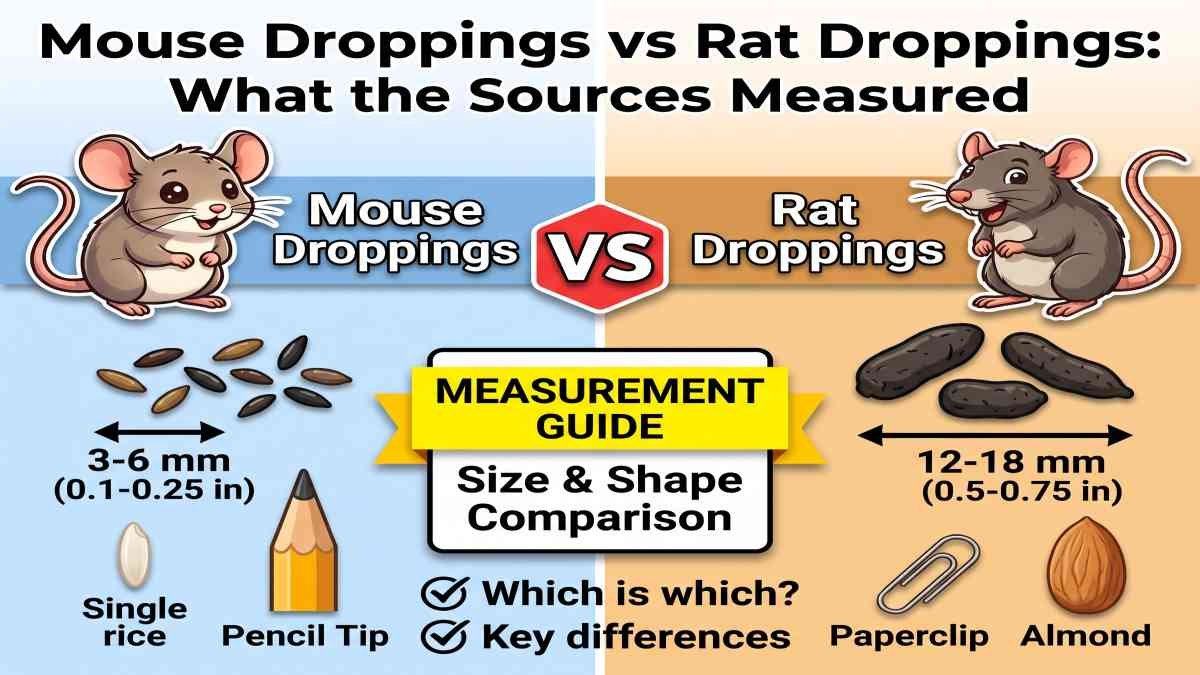
Mouse droppings vs rat droppings comes down to size first. Cornell’s NYS Integrated Pest Management program lists mouse droppings at 1/8 to 1/4 inch and Norway rat droppings at 3/4 to 1 inch. Size is the main clue, but one dropping can mislead, so look at the whole pile.
Rodent Control Syracuse is a homeowner resource, not a pest control company. We cover mice and rats in homes, and our homeowner guide to mice and rats explains the wider picture.
What University Sources Say About Dropping Size
How big are mouse and rat droppings? Cornell lists 1/8 to 1/4 inch for mice and 3/4 to 1 inch for Norway rats, UF/IFAS Extension gives 1/8 inch and 3/4 inch, and the University of Arizona lists 1/8 to 1/4 inch for house mice and 1/2 to 1 inch for rats.
Cornell’s NYS Integrated Pest Management program gives lengths for droppings by species in its guide to mouse and rat biology and behavior. The page shows no date, so we pair it with the dated UF/IFAS and University of Arizona figures.
The numbers differ because the sources do: UF/IFAS was revised in 2013, the Arizona bulletin dates from 1997, and Arizona says “rat droppings” without naming a species. No source gives a droppings-per-day figure, so we give none.
Mouse vs Rat Droppings at a Glance
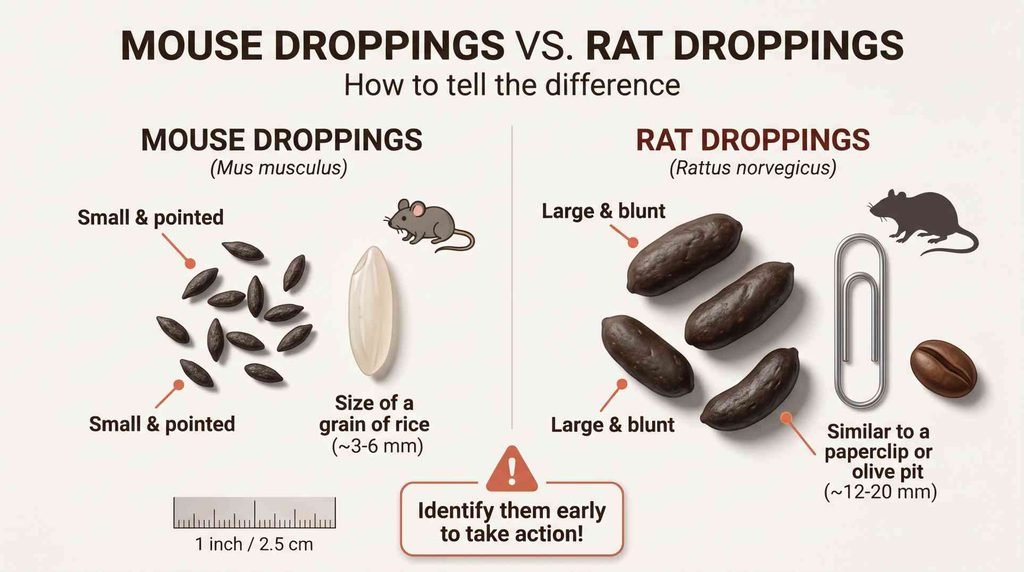
What is the difference between mouse and rat droppings? Mouse droppings are small, rod-shaped and pointed at both ends, while Norway rat droppings are longer, capsule-shaped and blunt at one end. Mouse droppings vs rat droppings differ mainly in length and shape.
Swipe left or right to see the full table →
| Feature | House mouse | Norway rat | Source |
|---|---|---|---|
| Length | 1/8 to 1/4 inch | 3/4 to 1 inch | Cornell NYS IPM |
| Length (single figure) | 1/8 inch | 3/4 inch | UF/IFAS Extension |
| Shape | Rod-shaped, pointed at both ends | Capsule-shaped, blunt at one end | UF/IFAS Extension; University of Arizona |
| Fresh vs old | Fresh: black, shiny, puttylike. Old: gray, dusty, crumble | Same | UF/IFAS Extension |
Note: These are typical adult droppings, and the sources differ slightly.
Seeing signs of mice or rats? Call, describe what you see, and ask for a written quote before work starts.
Rodent Control Syracuse is a homeowner resource that connects you with a participating local pest control company. We don’t perform the work ourselves, and we may receive a referral fee from participating companies. Response times and prices are set by the company that takes your call.
Are Rat Droppings Always Bigger? Why Size Alone Can Mislead
Are rat droppings always larger than mouse droppings? Not every time, because the sources describe typical droppings, and UF/IFAS notes that old droppings turn gray and crumble while fresh ones are black and shiny. Treat size as a clue, not proof.
Color adds confusion, since Cornell says it can differ with the food a rodent ate. We found no source on whether young rats leave smaller droppings, so we won’t claim it either way.
Look at the pile instead of one dropping: size, shape and where they sit. UC IPM lists droppings around pet food dishes and rat or mouse droppings in recycling bins among rat signs.
Do Not Sweep, Vacuum or Touch Them
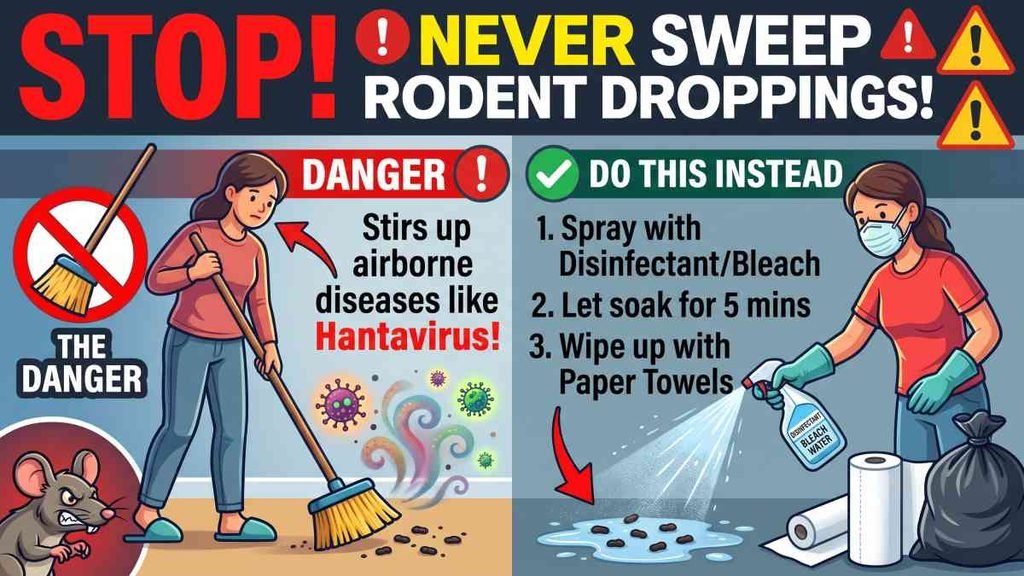
Should you touch or sweep rodent droppings? No: the CDC says not to vacuum or sweep rodent urine, droppings or nesting materials, because that can release tiny virus-containing droplets into the air, and UC IPM says feces can harbor pathogens, so always handle them with gloves.
The CDC also says many infected rodents show no visible illness, so a healthy-looking animal tells you nothing about its droppings. Its guide on how to clean up after rodents gives the wet-cleaning steps, the gloves and the disinfectant to use, so read it before you touch anything.
– Look from a distance with a flashlight.
– Take a photo with a ruler beside the droppings.
– Keep children and pets out of the area.
– Do not sweep or vacuum anything.
Rat Droppings in Syracuse: Which Species to Expect
Which rat leaves droppings in Syracuse homes? Cornell says roof rats are generally not found in New York, so the Norway rat is the rat this guide compares against the house mouse. We found no source on how many droppings Syracuse homes have, so we won’t guess.
Housing matters too. Reported by City-Data.com, the median Syracuse house or condo was built in 1938, and 58% of occupied housing is renter-occupied (35,971 of 61,878 units, 2000-2023 data). If you rent, tell your landlord in writing.
The Onondaga County Health Department lists complaint investigation among its services, at (315) 435-1649, though its rodents page does not cover droppings.
If You Are Still Not Sure, Describe What You Found
If you are unsure, describe the size, location and rough number of the droppings, and how long you have noticed them, to a participating local pest control company and ask what it sees, because droppings in a crawl space, a ceiling space or anywhere at height are a job for a professional. Our guide to what a rat control visit involves explains how that call usually goes. We don’t perform the work ourselves, and the company that takes your call sets the response time.
Quick Answers About Mouse and Rat Droppings
Cornell lists 1/8 to 1/4 inch. UF/IFAS gives 1/8 inch, and Arizona gives 1/8 to 1/4 inch. They are small and pointed.
Cornell lists Norway rat droppings at 3/4 to 1 inch, and UF/IFAS gives 3/4 inch. Arizona lists rat droppings at 1/2 to 1 inch. Use the range.
UF/IFAS calls mouse droppings rod-shaped and Norway rat droppings capsule-shaped. Arizona says mouse droppings are pointed at both ends and rat droppings are blunt at one end. Cornell adds that rodent droppings have no lines.
UF/IFAS says fresh droppings are black, shiny and puttylike, while old ones are gray, dusty and crumble. Cornell adds that color can change with the food eaten. Check the texture too.
Not reliably. The sources describe typical droppings, and we found none on young rats. Look at the whole pile and the other signs.
Treat them as unsafe to handle bare-handed. UC IPM says always use gloves, and the CDC says not to sweep or vacuum them. Many infected rodents show no visible illness.
Cornell says roof rats are generally not found in New York. So the usual comparison here is house mouse vs Norway rat. Describe the droppings to a company if you are unsure.
Conclusion
Mouse droppings vs rat droppings is mostly a question of length and shape: about 1/8 to 1/4 inch for mice and 3/4 to 1 inch for Norway rats, per Cornell. Treat size as a clue, leave the droppings alone and describe what you found.
Ready to talk to someone? Call, describe what you see, and ask for a written quote before work starts.
Rodent Control Syracuse is a homeowner resource that connects you with a participating local pest control company. We don’t perform the work ourselves, and we may receive a referral fee from participating companies. Response times and prices are set by the company that takes your call.