
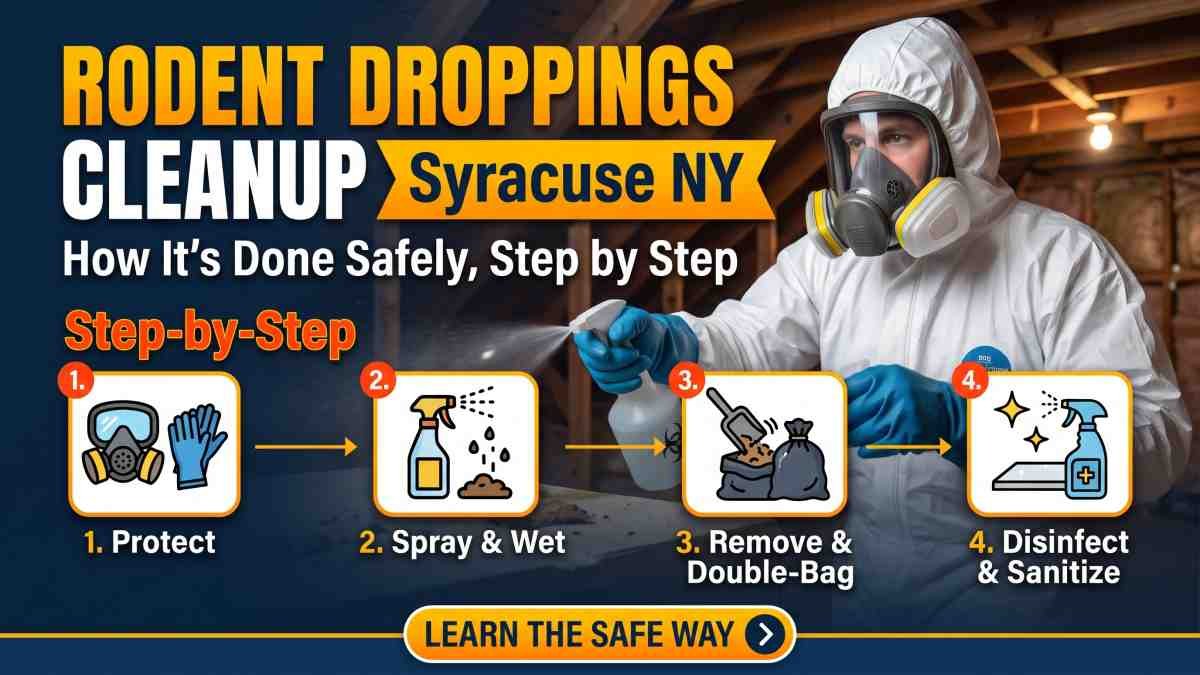
You found droppings in a cupboard, and the broom is right there. Put it down, because the CDC says sweeping or vacuuming rodent droppings, urine or nesting material can release virus-containing droplets into the air. Rodent droppings cleanup in Syracuse starts with gloves and a wet cloth.
Rodent Control Syracuse is a homeowner resource, not a pest control company. We cover mice and rats in homes, and our guide to rodent control in Syracuse explains the wider picture. This page covers rodent feces cleanup: the safe steps, the limits of doing it yourself and what a company should tell you.
Seeing signs of mice or rats? Call, describe what you see, and ask for a written quote before work starts.
Rodent Control Syracuse is a homeowner resource that connects you with a participating local pest control company. We don’t perform the work ourselves, and we may receive a referral fee from participating companies. Response times and prices are set by the company that takes your call.
Why You Never Sweep or Vacuum Droppings
Should you sweep or vacuum mouse droppings? No, because the CDC says doing so with rodent urine, droppings or nesting materials can release virus-containing droplets into the air. Wet them down with a disinfectant and wipe them up with paper towels instead.
This is common and fixable. Picture a mouse nest behind the water heater in an older Syracuse basement in January: the broom is within reach, and grabbing it is the habit. Put it back, and wet the droppings first.
Can Mouse Droppings Make You Sick? What the CDC Says
Can mouse droppings make you sick? Yes, because the CDC says rodents can spread disease through contact with droppings, urine or saliva, bites, breathing in air and contaminated food, and many show no visible illness. That is a reason for careful cleanup, not alarm.
Mouse droppings virus is what most people mean by the question. According to the CDC, people get hantavirus from rodents, especially when exposed to their urine, droppings and saliva. The most common hantavirus causing hantavirus pulmonary syndrome (HPS) in the US is spread by the deer mouse, and early symptoms usually appear 1 to 8 weeks after rodent contact.
On May 14, 2026, Ontario County health officials announced an investigation into a locally acquired hantavirus case, as reported by Spectrum News and WXXI News. They urged residents to wear masks and gloves when cleaning attics, sheds and cabins. We found no source on how common hantavirus is in Syracuse houses, so we make no claim about your risk.
Before You Touch Anything: A Safe-Steps Checklist
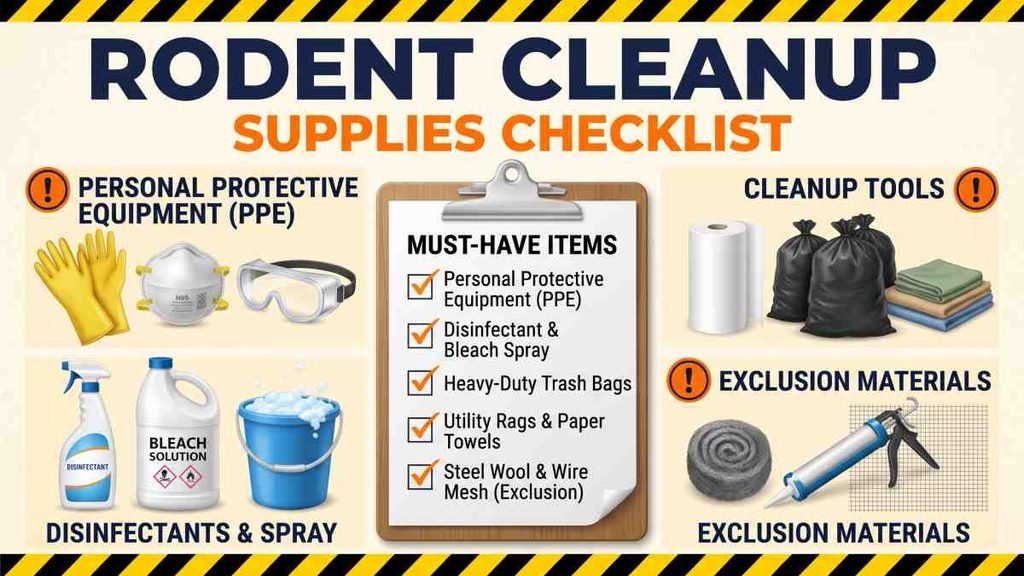
What should you do before cleaning up rodent droppings? Keep children and pets out, then open all doors and windows for 30 minutes and leave while the space airs out, as the CDC advises. Put on rubber or plastic gloves, and leave the broom and vacuum in the closet.
– Keep children and pets out of the room.
– Open doors and windows for 30 minutes before cleaning, and leave the space meanwhile.
– Put on rubber or plastic gloves.
– Gather paper towels, a disinfectant and plastic bags.
– Do not sweep or vacuum anything.
A rodent droppings clean up goes better with everything in reach before the first spray. Mouse droppings cleanup and rat droppings cleanup follow the same wet method. Outdoors, the CDC says to stay upwind when removing contaminated items.
How to Wet-Clean Droppings and Urine, Step by Step
How do you clean up mouse droppings safely? Wear gloves, spray the droppings and urine with a bleach solution or an EPA-registered disinfectant until very wet, and let it soak for 5 minutes or as the label says. Wipe it up with paper towels, bag them, then mop hard surfaces and wash your hands.
Spray, soak and wipe
The CDC says to put on rubber or plastic gloves, spray urine and droppings with a bleach solution or an EPA-registered disinfectant until very wet, and let it soak for 5 minutes or as the label says before wiping it up with paper towels. Its guide on how to clean up after rodents also gives the bleach dilution and the steps for dead rodents, nests and used traps, so follow the CDC page rather than a number from memory.
To disinfect an area contaminated by rodents, the CDC accepts either choice, so mouse droppings disinfectant does not need to be fancy. If you pick a bleach solution for rodent droppings, make it fresh before use, as the CDC says. Put the used paper towels in a covered garbage can that is emptied regularly, then mop hard surfaces with disinfectant.
Dead rodents, nests and used traps
For a dead rodent, a nest or a used trap, wear gloves and spray the rodent, the nest and the area around them with disinfectant, then let it soak. Place the rodent or nesting material and any used traps in a plastic bag, tie it, and put that bag inside a second bag. The CDC then says to use a covered, regularly emptied garbage can, or to ask the state health department about other disposal options.
Wash up
Finish by washing your gloved hands, removing the gloves and washing your hands with soap and warm water. Washing before you take the gloves off is the CDC’s order, so follow it.
When Cleanup Is Not a DIY Job
Do you need professional cleanup for rodent droppings? Sometimes. The CDC calls for special precautions in heavy infestations, vacant buildings with large rodent populations and places where rodent-borne disease is confirmed, and says to contact a professional if rodents have reached heating or cooling systems.
Honestly, a few droppings behind a kitchen cabinet are a job for gloves, disinfectant and paper towels. A long-running problem in an empty house is not. On those jobs the CDC says clean-up crews should use coveralls, rubber boots or shoe covers, gloves, goggles and a respirator.
Crawl spaces, ceiling spaces and anything at height belong to a professional, and the CDC page doesn’t cover attics, so read why attic jobs carry extra safety risks first. Who cleans up mouse droppings in Syracuse? You can handle a small job, and a company should handle the rest.
Heard it again tonight? Call, describe what you see, and ask for a written quote before work starts.
Rodent Control Syracuse is a homeowner resource that connects you with a participating local pest control company. We don’t perform the work ourselves, and we may receive a referral fee from participating companies. Response times and prices are set by the company that takes your call.
What a Professional Cleanup Includes, and What It Does Not
What does rodent droppings cleanup include? It varies by company, so ask for the list in writing; the CDC describes the core work as protective gear, disinfecting droppings, urine and nesting material, double-bagging waste and disposing of it. Cleanup alone does not stop the rodents.
Assessment: where the droppings and nesting material are
The first job is finding where the droppings and nesting material are. Companies differ in how they do this, so ask what the visit covers. Does the cleanup include urine and nesting materials, or only the droppings you can see?
Protective gear and containment
For heavy jobs the CDC lists coveralls, rubber boots or shoe covers, gloves, goggles, and either a half mask air-purifying respirator with HEPA filters or a powered air-purifying respirator. Ask which of these the crew will wear on your job. A vague answer tells you something too.
Disinfecting, bagging and disposal
How do professionals remove rodent droppings? The core steps match the CDC page: spray until very wet, let it soak, wipe up, then double-bag the waste and use a covered garbage can. A company that skips the soak or the second bag is skipping steps the CDC lists.
What cleanup does not do
Cleanup removes what rodents left behind. It does not stop new droppings, and the CDC says that if droppings remain after cleaning an area, rodents are likely still active.
Insulation is a gray area. We found no source on when contaminated insulation must be replaced, so ask the company, in writing, how it handles insulation and what that adds to the quote.
Cleanup, Trapping and Sealing: What Each Job Fixes
Is rodent cleanup the same as pest control? No, because the CDC describes three separate steps for controlling a wild rodent infestation: trap up, seal up and clean up. Cleanup removes droppings and nesting material, trapping removes the rodents, and sealing closes the gaps.
Swipe left or right to see the full table →
| Job | What it does | What it doesn’t do | Source |
|---|---|---|---|
| Clean up | Removes droppings, urine and nesting material with wet-cleaning and disinfectant | Does not remove live rodents or close entry gaps | CDC |
| Trap up | Removes the rodents that are inside | Does not clean what they left or close the gaps | CDC |
| Seal up | Closes the gaps rodents use to get in | Does not remove rodents already inside or clean droppings | CDC |
Note: This table shows what each job is for, not how well any company does it. We found no verified success rates, so we list none.
Rodent cleanup vs pest control comes down to which job you are paying for. Ask any company which of the three your quote covers.
Syracuse Houses, Rentals and Who to Call Locally
Syracuse housing makes this a common question. Reported by City-Data.com, the median Syracuse house or condo was built in 1938, and 58% of occupied housing is renter-occupied (35,971 of 61,878 units, 2000-2023 data). These are third-party figures, and we don’t claim they predict droppings in any one home.
If you rent, check your lease and tell your landlord in writing. We found no source on New York landlord and tenant duties for pests, so we won’t state any. You can also check with the City or the Onondaga County Health Department.
The Onondaga County Health Department lists complaint investigation among its environmental health services. Its page on rodents gives a phone number, (315) 435-1649, and links to CDC, EPA and New York State Department of Health rodent resources. It does not cover droppings cleanup or landlord rules, so we make no claim about either.
Before You Say Yes: Seven Questions for a Cleanup Company
Which questions should you ask a cleanup company? These seven cover the work, the gear and the paperwork.
1. What exactly is included: droppings, urine, nesting material and disposal? Why it matters: Companies differ, and a vague list is hard to compare.
2. What protective gear will the crew use? Why it matters: The CDC lists coveralls, boots or shoe covers, gloves, goggles and a HEPA respirator or powered respirator for heavy jobs.
3. Which disinfectant is used, and is it EPA-registered? Why it matters: The CDC accepts a bleach solution or an EPA-registered disinfectant.
4. How is waste bagged and disposed of? Why it matters: The CDC describes double-bagging and a covered garbage can.
5. Is the work insured? Why it matters: The EPA tells homeowners to check a pest control company’s license and insurance.
6. Will the quote be in writing and list the work and the total? Why it matters: A written total lets you compare companies.
7. How will porous items such as insulation be handled, and what happens afterward? Why it matters: We found no source on when they must be replaced, so get the answer in writing.
What about the price? We found no verified Syracuse price for rodent droppings cleanup, so we won’t invent one. Price follows the work, and our guide to how quotes for rodent work are priced explains the factors.
Insurance is a separate question. Policygenius reports (updated October 2022) that standard homeowners insurance generally doesn’t cover rodent damage or removal of an infestation, though a fire from chewed wiring may be covered. Read your own policy.
Straight Answers About Rodent Droppings Cleanup in Syracuse
No. The CDC says not to vacuum or sweep rodent urine, droppings or nesting materials, because that can release virus-containing droplets into the air. Wet-clean them instead, as the steps on this page describe.
They can. The CDC says rodents can spread disease through contact with droppings, urine or saliva, bites, breathing in air and contaminated food. Many infected rodents show no visible illness, so careful cleanup matters either way.
The CDC says people get hantavirus from rodents, especially when exposed to their urine, droppings and saliva. The most common hantavirus causing HPS in the US is spread by the deer mouse. We found no source on how common it is in Syracuse houses.
The CDC accepts a bleach solution or an EPA-registered disinfectant, sprayed until the droppings are very wet. Let it soak for 5 minutes or as the label says. If you use bleach, follow the CDC’s published dilution and make it fresh.
Open doors and windows for 30 minutes and leave, then put on rubber or plastic gloves. Spray the droppings until very wet, let them soak, wipe them up with paper towels and bag them. Mop hard surfaces with disinfectant and wash your hands with soap and warm water.
For a few droppings, often not. The CDC calls for special precautions in heavy infestations and vacant buildings with large rodent populations, and for rodents in heating or cooling systems it says to contact a professional. Anything at height or in a crawl space belongs to a professional too.
It varies, so ask for the list in writing. The CDC describes protective gear, disinfecting droppings, urine and nesting material, double-bagging and disposal. Ask about insulation separately, since we found no source on when it must be replaced.
No. The CDC lists three steps: trap up, seal up and clean up. It also says that if droppings remain after cleaning an area, rodents are likely still active, which points to trapping and sealing.
Policygenius reports that standard homeowners insurance generally doesn’t cover rodent damage or removal of an infestation. It adds that a fire caused by chewed wiring may be covered. We can’t see your policy, so read it or ask your insurer.
We found no verified Syracuse price, so we won’t give a number. Price follows the work: how much there is, where it is and what protection the crew needs. Ask for a written quote that lists the work and the total.
Describe What You Found, Then Ask for a Written Quote
Rodent droppings cleanup in Syracuse goes best when you know the steps and the limits. Describe what you found and where, and ask for the quote in writing before work starts.
Ready to talk to someone? Call, describe what you see, and ask for a written quote before work starts.
Rodent Control Syracuse is a homeowner resource that connects you with a participating local pest control company. We don’t perform the work ourselves, and we may receive a referral fee from participating companies. Response times and prices are set by the company that takes your call.