
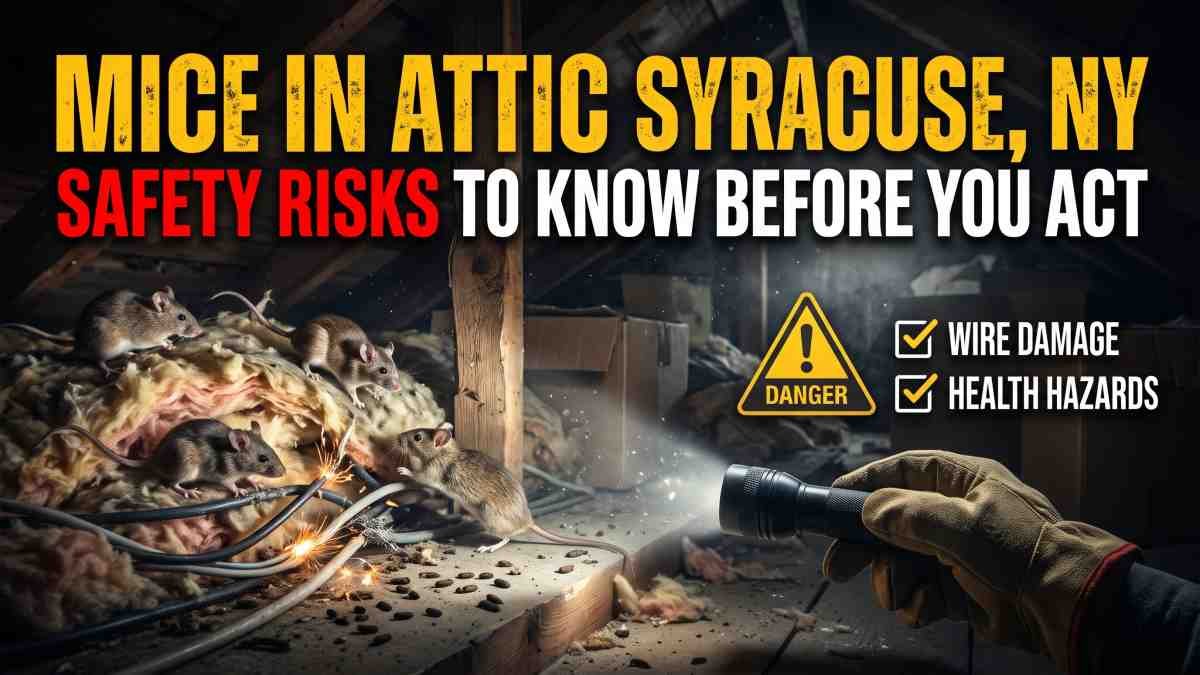
Rodents above a ceiling are a safety problem before they are a nuisance. UC IPM, the University of California’s pest management program, says many fires of unknown origin are believed to be caused by rodents gnawing on wires, and that dead mice can end up inside walls. So mice in an attic in Syracuse deserve care, not guesswork.
Rodent Control Syracuse is a homeowner resource, not a pest control company. We cover mice and rats in homes, and our guide to rodent control in Syracuse explains the wider picture. This page is about mice in attics.
Seeing signs of mice? Call, describe what you see, and ask for a written quote before work starts.
Rodent Control Syracuse is a homeowner resource that connects you with a participating local pest control company. We don’t perform the work ourselves, and we may receive a referral fee from participating companies. Response times and prices are set by the company that takes your call.
Why Mice Above Your Ceiling Are More Than a Noise Problem
Why are mice in the attic a problem? UC IPM says many fires of unknown origin are believed to be caused by rodents gnawing on wires, and dead mice may end up inside walls, causing odor. A female may also have 5 to 10 litters a year, of about 5 or 6 pups each.
Note the wording: believed to be caused. We won’t tell you a fire is coming, only that a long-running attic mice infestation gives the wires and the breeding numbers more time to matter.
Picture an older Syracuse house with the attic hatch in a hallway ceiling, right above bedrooms. The first scratching is a reason to learn the signs, not to panic.
Signs of Mice in Your Attic: What to Look For and What Not to Touch
What are the signs of mice in an attic? UC IPM lists droppings, gnaw marks, tracks and nests of shredded fibrous material. The University of Arizona adds insulation pulled out or in unexpected places, and UC IPM notes a musky odor in large or long-term infestations.
Swipe left or right to see the full table →
| Sign | What to look for | Source |
|---|---|---|
| Droppings | Reveal house mouse activity | UC IPM |
| Gnaw marks | Reveal house mouse activity | UC IPM |
| Tracks | Tracks or footprints, for example in dust | UC IPM and University of Arizona |
| Nests | Built in sheltered locations from finely shredded paper or other fibrous material | UC IPM |
| Insulation | Pulled out or in unexpected places | University of Arizona |
| Odor | A musky smell, common in large or long-term infestations | UC IPM |
Note: This table lists signs, not proof. We can’t see your attic, and one sign alone doesn’t confirm mice.
If you look for mice in attic signs, do it from the hatch with a flashlight, and leave any droppings where they are. Describe what you see to a company instead of sweeping it up.
The CDC says to put on gloves and soak urine and droppings with a bleach solution or an EPA-registered disinfectant before wiping them up, rather than sweeping or vacuuming. Its guide on how to clean up after rodents also lists a half mask respirator with HEPA filters for heavy infestations, and it does not cover attics, so ask a company how it handles one.
What Scratching at Night Tells You
What do mice in the attic sound like at night? The University of Arizona says house mice are nocturnal, so listen for quiet scampering and scratching above ceilings. Occasional squeaks are more common at night, while steady, predictable sounds may point to something mechanical.
Because house mice avoid light, you’re most likely to hear mice in the attic at night, when the house is quiet. Scratching noises in the attic at night aren’t proof of mice, though, so write down when and where you hear them and describe that when you call.
How Mice Reach the Attic: Roof Vents, Soffits and Utility Gaps
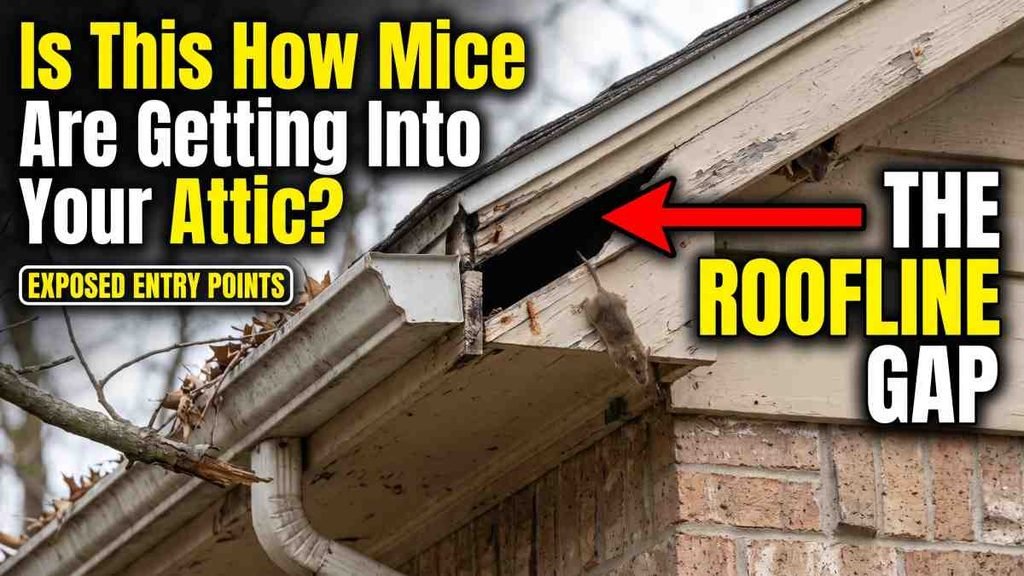
How do mice get into an attic? UC IPM says house mice squeeze under gaps 1/4 inch tall and through openings 3/8 inch wide, and climb rough vertical surfaces. The CDC says to check the roof area, including rafters, gables, eaves and soffits, plus vents and utility holes.
Can mice enter through roof vents? Yes, if the vent has a gap larger than 1/4 inch or a gnawable cover.
Can mice climb exterior walls to reach an attic? UC IPM says they jump up to 12 inches onto a flat surface, so a high roofline isn’t automatically out of reach.
The CDC also lists the gap between the foundation and the ground, and holes for utility lines. We found no source on which route is most common, so for mice in attic Syracuse cases the route is whichever gap an inspection finds.
What You Can Do Tonight, and What Belongs to a Professional
Is it safe to remove mice from your attic yourself? Keep children and pets away from the hatch and leave droppings alone, but poison, heavy infestations, work at height and wiring concerns belong to a professional, because mistakes there can hurt people, pets and your home.
– Keep children and pets away from the attic hatch.
– Store food in sealed containers.
– Don’t sweep or vacuum droppings (CDC).
– Don’t set out poison. UC IPM says all rodenticides are toxic to people, pets and wildlife.
– Write down what you hear and when.
A few droppings near the hatch are a smaller job than a long-running problem. The CDC says to contact a professional if rodents have entered heating and cooling systems, and the same sense applies to wiring and work at height.
Heard it again tonight? Call, describe what you see, and ask for a written quote before work starts.
Rodent Control Syracuse is a homeowner resource that connects you with a participating local pest control company. We don’t perform the work ourselves, and we may receive a referral fee from participating companies. Response times and prices are set by the company that takes your call.
How a Professional Treats an Attic, Step by Step
How do professionals remove mice from an attic? Following UC IPM and CDC guidance, the work has four parts: inspection, trapping or baiting, sealing gaps with metal rather than foam, and sanitation with a follow-up visit. Companies differ, so ask which parts your quote includes.
Attic mice control isn’t one tool. UC IPM calls exclusion, meaning sealing the gaps, the most successful and permanent form of house mouse control. For a visit that covers the whole house, see our guide to what a mouse control visit involves in Syracuse.
Inspection: The Roofline, Vents and Utility Openings
An attic rodent inspection in Syracuse starts with the places the CDC lists: rafters, gables, eaves, soffits, vents and utility holes. The aim is every opening larger than 1/4 inch.
Trapping and Bait Stations
UC IPM says to use multiple traps so the trapping period stays short. In an attic, that’s the company’s job, not a weekend project.
Sealing With Metal, Not Foam
UC IPM says gnawable materials such as plastic, rubber, expanding foam and wood are ineffective, and to seal with metal or concrete. The CDC recommends steel wool for small holes and hardware cloth or metal sheeting for larger ones.
Sanitation and the Follow-Up Visit
The CDC’s wet-cleaning steps cover droppings, but its page says nothing about attics. Ask how the company handles attic droppings, and what its follow-up visit includes.
Traps, Bait Stations or Sealing in an Attic: What Each Does
Traps remove mice already inside, bait stations hold rodenticide, and sealing closes the gaps mice use. UC IPM says all rodenticides are toxic to people, pets and wildlife, and that poisoned mice may die inside walls. Poison vs snap traps for attic mice is worth asking about before you agree to the work.
Swipe left or right to see the full table →
| Method | What it does | What it doesn’t do | Risk |
|---|---|---|---|
| Traps | Remove mice already inside. UC IPM says use multiple traps so the trapping period stays short | Don’t close the entry points | Ask who sets and checks them |
| Bait stations | Hold rodenticide in a container. The EPA requires consumer products to come with bait stations | Don’t close the entry points | Poisoned mice may die inside walls, and pets and wildlife can be poisoned (UC IPM, EPA) |
| Sealing | Closes gaps larger than 1/4 inch with metal or concrete (UC IPM) | Doesn’t remove mice already inside | Foam, plastic, rubber, vinyl and wood are ineffective (UC IPM) |
Note: This table summarizes UC IPM, EPA and CDC guidance. We show no success rates, because we can’t verify any.
What to Ask About Insulation After Mice
Can mice damage attic insulation? The University of Arizona lists insulation pulled out or in unexpected places as a sign of mouse activity. Beyond that, we found no source that says when insulation must be replaced, and the CDC’s page on cleaning up after rodents mentions neither attics nor insulation.
Should attic insulation be replaced after mice? That’s a question for the company and its own inspection. Ask, in writing, whether the price covers the mice only or the insulation too.
Syracuse Winters and Older Houses: What the Sources Show
Does cold weather drive mice into attics in Syracuse? Cornell’s IPM program notes that deer mice move indoors in autumn as temperatures drop, but we found no source on house mice, so this page makes no promise about mice in the attic during winter. Syracuse averages 127.8 inches of snow a year, as reported by CurrentResults citing NOAA’s 1991-2020 normals.
City-Data reports a median build year of 1938 for Syracuse houses and condos, and says 58% of occupied housing is renter-occupied (35,971 of 61,878 units). These are third-party figures. In an older Syracuse home, the roof area and the foundation gap are both on the CDC’s list.
If you rent, check your lease and tell your landlord before you pay for anything. For building rules, ask the City of Syracuse or the Onondaga County Health Department.
Before You Say Yes: Seven Questions for an Attic Mouse Company
What should you ask a company before it works in your attic? Start with its New York registration and the technician’s certification, then ask about methods, pet safety, entry points, the written quote and the follow-up. Each question comes with its reason.
1. Is the business registered with the NYS DEC, and is the technician certified? Why it matters: Certification is required to apply any pesticide commercially, and you can look both up in the state’s database.
2. Is the work insured? Why it matters: The EPA tells homeowners to check for appropriate insurance.
3. What methods and products will go into my home? Why it matters: Traps, bait stations and sealing carry different risks, as the table above shows.
4. Are children or pets at risk, and how is that handled? Why it matters: UC IPM says all rodenticides are toxic to people, pets and wildlife.
5. Will the quote be in writing and list the work and the total? Why it matters: A written total lets you compare companies.
6. Which entry points will be sealed, and with what? Why it matters: UC IPM says foam, plastic, rubber, vinyl and wood are ineffective on gaps larger than 1/4 inch.
7. What does the follow-up include, and what happens to the insulation? Why it matters: Ask for both in writing, because neither is easy to guess from a phone call.
In New York, certification is required to apply any pesticide commercially, and a business that offers pesticide services for hire must be registered with the state’s Department of Environmental Conservation. The DEC’s page on pesticide applicator and technician certification points homeowners to its pesticide administration database, where you can look up a business’s registration and an individual’s certification.
What about the price? We found no verified Syracuse price for attic mouse removal, so we won’t invent one. Price follows the work, and our guide to how rodent exclusion quotes are priced explains the factors.
Straight Answers About Mice in the Attic
UC IPM lists droppings, gnaw marks, tracks and nests of shredded fibrous material. The University of Arizona adds insulation pulled out or in unexpected places, and UC IPM notes a musky odor in large or long-term infestations. If you aren’t sure, describe what you see when you call.
The University of Arizona says to listen for quiet scampering and scratching above ceilings, with occasional squeaks that are more common at night. House mice are nocturnal. Steady, predictable sounds may be mechanical instead.
They can be. The CDC says rodents can spread disease through contact with droppings, urine or saliva, through bites, and by breathing in or eating contaminated material. UC IPM adds that rodent gnawing on wires is believed to cause many fires of unknown origin. Leave heavy problems to a professional.
UC IPM says many fires of unknown origin are believed to be caused by rodents gnawing on wires. That wording is cautious, and so are we. If you suspect chewed wiring, call a professional.
UC IPM says house mice squeeze under gaps 1/4 inch tall and through openings 3/8 inch wide, and climb rough vertical surfaces. The CDC lists the roof area, vents, utility holes and the gap between the foundation and the ground. A company should check all of them.
We found no source that says they do. UC IPM calls exclusion the most successful and permanent form of house mouse control, and a female may have 5 to 10 litters a year. Waiting gives the problem more time, not less.
Keeping children and pets away, storing food and leaving droppings alone are fine. Poison, heavy infestations and work at height aren’t, because UC IPM says all rodenticides are toxic to people, pets and wildlife. Ask a company instead.
Following UC IPM and CDC guidance, the work covers an inspection, trapping or baiting, sealing the gaps with metal, and sanitation with a follow-up visit. Companies differ, so ask which steps are in your quote. Get it in writing.
We found no source that says when it must be. The University of Arizona treats pulled-out insulation as a sign of activity, and the CDC’s cleanup page doesn’t mention attics. Ask the company, in writing, whether its price covers the insulation.
Policygenius reports that standard homeowners insurance generally doesn’t cover rodent damage or removal of an infestation. It adds that a fire caused by chewed wiring may be covered. Read your own policy or ask your insurer, since we can’t see it.
Describe What You Hear, Then Ask for a Written Quote
Mice in an attic in Syracuse are easier to deal with once you know what to ask. Describe what you hear and see, and ask for the quote in writing before work starts.
Ready to talk to someone? Call, describe what you see, and ask for a written quote before work starts.
Rodent Control Syracuse is a homeowner resource that connects you with a participating local pest control company. We don’t perform the work ourselves, and we may receive a referral fee from participating companies. Response times and prices are set by the company that takes your call.